
[ad_1]
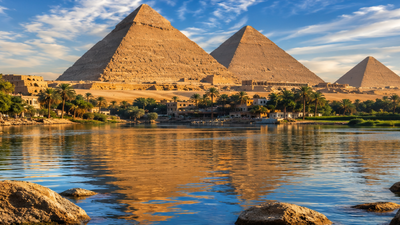
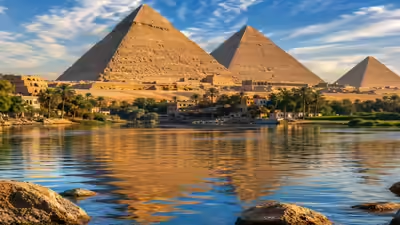
If you’ve spent any time on TikTok or history subreddits, you’ve definitely seen the wild theories on how the Great Pyramid of Giza was built. Aliens, lost future civilisations, complicated sound-wave levitation- people will believe anything rather than admit humans just figured it out.Looking at the modern landscape, the scepticism is somewhat justified. Today, the Great Pyramid emerges from a sun-bleached desert, the Nile River a brutal four miles away. It is an engineering fever dream to imagine Bronze Age workers hauling 2.3 million stone blocks, each weighing more than two tons, across miles of searing sand.But a major environmental breakthrough suggests we have been looking at the problem the wrong way. The ancient Egyptians didn’t work harder; they worked smarter. They used a massive, forgotten water highway that ran right to the foot of the Giza Plateau.The ancient green corridor below the sandThe world was a different place 4,500 years ago, under the rule of Pharaohs Khufu, Khafre and Menkaure. Giza was not a desert wasteland, but a busy port city on the harbour front.An international team of scientists literally drilled into the history of the landscape to prove this. In a groundbreaking research paper published in the Proceedings of the National Academy of Sciences, researchers extracted fossilised pollen grains from deep sediment cores under the modern Giza floodplain.By analysing these microscopic ancient plants, the team built up an 8,000-year history of the local environment. They found many marsh-loving plants and flowering river grasses that grow only in stable, deep water. The data confirmed the existence of a long-lost, naturally high-volume channel of the Nile, called the Khufu Branch, that flowed right by the pyramid construction sites.This was no shallow creek. At the height of pyramid building, the Khufu Branch was operating at roughly 40% of its Holocene maximum capacity. Thus, it was deep enough and wide enough to allow cargo boats to travel with ease, a maritime highway straight from distant quarries to the Giza Plateau.
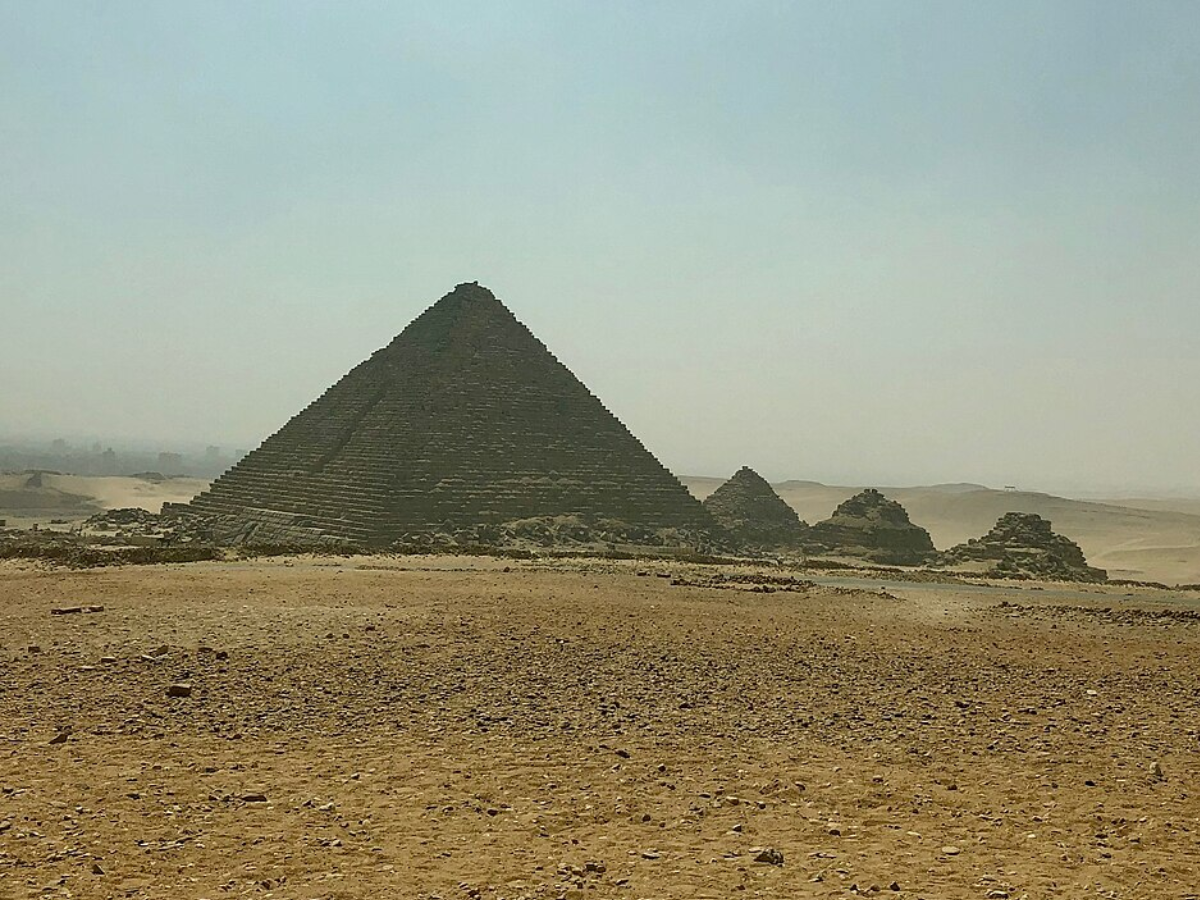
Scientific evidence reveals this ‘water highway’ flowed directly to Giza, proving they worked smarter, not harder. Image Credit: Wikimedia Commons
Engineering with the flow of natureWhere the ancient Egyptians weaponised geography rather than brutalising human labour across miles of sand, they constructed a complex of harbours and canals, directly connected to this natural river branch, creating a highly organised logistical hub.The environmental evidence is strengthened by a wealth of first-hand testimony from the people who actually did the work. Another very influential study looked at the Journal of Merer, where researchers examined logbooks written on ancient papyrus unearthed near the Red Sea.The logs are kept by an elite inspector named Merer, and they describe the daily operations of a crew of some 200 men who took high-quality limestone blocks from the quarries of Tura straight to Giza. Merer gives a detailed account of the loading of the huge stones onto boats, their transport down the Nile and then through a network of artificial canals to the very ‘Pool of Khufu’, the huge harbour complex fed by the Khufu Branch.Engineers probably used the annual flooding of the Nile as a natural hydraulic lift, rather than relying solely on muscle power. They built deep-water basins that filled up in the high-water season, so that heavy transport boats could float right up to the base of the construction ramps.When the cosmic freeway dried upSo where did this giant river highway go? The answer is a gradual, worldwide change in climate.The pyramids were built just at the end of the African Humid Period, when Northern Africa received a much higher volume of rainfall than it does today. Over centuries, small variations in the amount of solar radiation received by the Earth gradually dried East Africa out.With the failure of the rains and the steady decrease of the Nile water levels, the Khufu Branch began to lose its depth. By the time King Tutankhamun ascended the throne centuries later, the waterway had greatly diminished. Eventually, it dried up entirely, choked out by centuries of blowing desert sand and shifting agricultural needs.The disappearance of the river branch effectively sealed the pyramids away in the deep desert, creating the geographical mystery that has baffled historians for generations. The ancient Egyptians did not need cosmic help to create the wonders of the ancient world. All they had to do was learn their local ecosystem, learn river logistics like the back of their hand, and get a little help from nature, exactly at the right moment.
[ad_2]
Source link


Комплексное лечение http://www.medprime-clinic.ru/ и диагностика заболеваний с использованием современных медицинских методов. Полное обследование организма, точная постановка диагноза, индивидуальный план терапии, консультации специалистов и эффективное лечение с учетом особенностей здоровья пациента.
Пройдите комплексное лечение https://medprime-clinic.ru и диагностику в медицинском центре. Полный спектр обследований, консультации профильных специалистов, современные методы лечения, контроль состояния здоровья и индивидуальный подход на всех этапах медицинской помощи.