[ad_1]
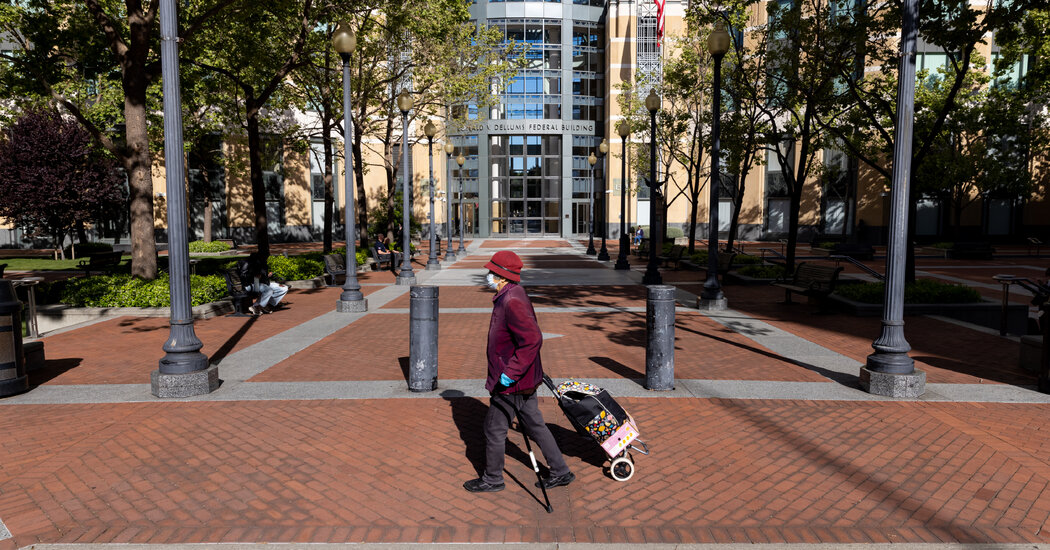
Over the next month or so, a who’s who of the technology industry is expected to appear in the Ronald V. Dellums U.S. Courthouse in Oakland, Calif., for a legal showdown between Elon Musk and the artificial intelligence company OpenAI.
Mr. Musk, the richest man in the world, should spend quality time on a witness stand, as will Sam Altman, the billionaire chief executive of OpenAI.
Satya Nadella, Microsoft’s chief executive, is expected to testify. Shivon Zilis, a former OpenAI board member and the mother of at least four of Mr. Musk’s children, is on the witness list. So is Tasha McCauley, another former OpenAI board member who tried to fire Mr. Altman.
That Oakland is playing host to this tech industry pantheon is one of the many oddities in this high-stakes trial. While plenty of tech workers live in Oakland, only a handful of tech companies are based in “The Town,” as locals call it. The go-go tech culture of San Francisco and Silicon Valley is notably absent in this city, even though it is only about 12 miles from OpenAI’s headquarters.
“Oakland is an interesting city for this to happen in, because we’re kind of thought of as the other town,” said Lesley Mandros Bell, an artist and teacher who has lived in Oakland for nearly four decades.
Mr. Musk says that Mr. Altman and other OpenAI executives tricked him into giving money to start OpenAI as a nonprofit lab that was supposed to be dedicated to making A.I. that was safe for humanity.
Today, OpenAI is a for-profit company and one of the most influential tech companies in the world, very likely on its way to one of the biggest public offerings in history. Mr. Musk left OpenAI after a power struggle with Mr. Altman. (He has his own A.I. company now.) His lawsuit is asking for $150 billion and an order that OpenAI revert to its nonprofit status.
(The New York Times sued OpenAI and Microsoft in 2023, accusing them of copyright infringement of news content related to A.I. systems. The two companies have denied those claims.)
The Oakland federal courthouse is part of a soaring, postmodern complex built in 1993 and named for Ronald Dellums, a longtime congressman whose district included Oakland and who served as the city’s mayor from 2007 to 2011. But Mr. Dellums, who died in 2018, might have frowned upon the ruthless capitalism that will be on display in the building named after him. He was a Democratic Socialist whose politics landed him on former President Richard M. Nixon’s “enemies list.”
“We start with a humanistic value system and ask: What inhibits life and growth?” Mr. Dellums said in an interview in 1976. “The answer is war, pollution, elitism, corporate corruption, corporate power that controls over 90 percent of the wealth and dominates people’s lives.”
The courthouse is next to a quiet downtown that has struggled since the pandemic. In the first quarter of this year, nearly 40 percent of downtown Oakland’s office space was empty, according to the real estate company Cushman & Wakefield. That vacancy rate has been stubbornly high, even as downtown San Francisco’s has ticked down over the past year to about 30 percent.
The city center across the street from the federal courthouse, for example, has more than a dozen empty storefronts. On a recent Monday, the shopping and office plaza had few — and sometimes no — pedestrians, save a janitor sweeping some stray trash.
Historically a blue-collar city known for manufacturing and trade with one of the best food scenes in the country, Oakland’s average income is two-thirds that of San Francisco’s, as is the median value of a home. The economy of the city, whose population is just over half of San Francisco’s, is built more on health care and government than technology companies. The tallest building in Oakland, at 404 feet, is the headquarters of the health care giant Kaiser Permanente; the tallest in San Francisco, at 1,070 feet, is home to the software company Salesforce.
“We’ve always been a part of the Bay Area, but adjacent,” said Ashleigh Kanat, the city’s director of economic and work force development. “We’ve always had a more diverse economic base.”
In recent years, Oakland has developed a reputation as a city down on its luck. It lost three professional sports teams — the Warriors, the Raiders and the Athletics — in quick succession. It struggled with crime and homelessness after the pandemic, along with a bad budget deficit. In 2024, voters recalled the mayor, Sheng Thao, who was later indicted on corruption charges.
Some of those woes have eased. Last year, violent crimes declined 25 percent from the year before, while vehicle thefts declined 40 percent.
Parts of downtown Oakland show improvement, like a weekly farmers’ market that teems with grandmothers haggling over vegetables and residents chatting with longtime vendors at fruit stands. But those pockets of foot traffic are surrounded by buildings and offices for sale or for lease.
“The market has been quicker to recover in San Francisco than it has in Oakland,” said Robert Sammons, a senior director of research at Cushman & Wakefield. But, he added, “as San Francisco goes, so goes Oakland a couple of years later, usually.”
That the trial is even being held in Oakland was a bit of the luck of the draw. In the Northern District of California, cases are randomly assigned to judges who sit in courthouses in San Francisco, Oakland and San Jose.
The Oakland courthouse has seen trials involving technology companies before. The judge hearing this case, Yvonne Gonzalez Rogers, presided over Epic Games’s lawsuit against Apple. As the trial of Mr. Musk and OpenAI gets underway, other judges in the courthouse are scheduled for meetings about cases involving Uber and Salesforce.
Still, locals said they are unimpressed by the tech celebrities.
“We have bigger issues to think about,” said Diana Hernandez, who has lived in Oakland for more than a decade and co-owns Chef Sarah Germany, which makes sauces and pickles using local produce. “I’m more concerned about the people on my block.”
And, of course, there are worries about crowded streets and sidewalks. “I’m not looking forward to the spectacle of it,” said Victor Harris, who was born and raised in Oakland and owns Reuschelle’s Cheesecakes, a local cheesecake business. “I can see it diverting traffic.”
Selecting nine people for a jury pulled from Oakland and an area stretching from the wine country to the north and parts of Silicon Valley to the south could be a challenge. In 2023, during a trial involving Mr. Musk in San Francisco, a lawyer for the multibillionaire questioned potential jurors about their ability to remain neutral, so much so that the judge warned him that his speeches were “passing a line.”
“The biggest problem is the fact that you have people who have been in the news a lot,” said Jeremy Fogel, who was a judge in the Northern District of California from 1998 to 2018. “Musk, in particular, is kind of a controversial guy, so people are going to have opinions about him.”
Case in point: A protest targeting Mr. Musk and Mr. Altman is planned for the first day of the trial, outside the federal courthouse.
The theme: “Everyone sucks here.”
[ad_2]
Source link