[ad_1]
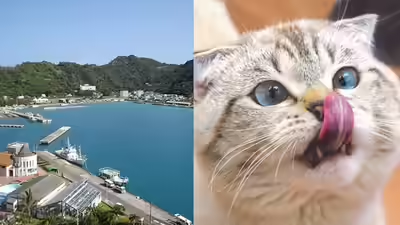
After ecologists moved 131 feral cats away from Chichijima Island, which is located in the Ogasawara archipelago, this island became a topic of interest for ecological research. This wildlife conservation initiative undertaken at Chichijima Island in Japan has since received much attention in the field of conservation biology, as removing the cats caused the ecosystem of this island to recover much faster than predicted by ecologists. Ecologists who studied biodiversity recovery noticed how quickly positive changes started to occur in the seabird population, as well as the activities of native reptiles and the regeneration of forests, as soon as the cats were removed.
Why invasive cats became one of the biggest threats to Japan’s Chichijima Island
Chichijima Island is part of the Ogasawara Islands, a UNESCO World Heritage site known for its unique and highly endemic biodiversity. Before intervention, feral cats had become one of the most damaging invasive predators, heavily affecting native bird species and small reptiles.According to the study titled ‘Genetic purging in an island-endemic pigeon recovering from the brink of extinction’ supported by the Ministry of the Environment, Japan, feral cats were removed through a structured relocation and control programme designed to reduce predation pressure on native wildlife.Island ecosystems are particularly sensitive because species evolve without large land predators. When invasive predators like cats are introduced, they can rapidly disrupt ecological balance.
Relocation of 131 cats and conservation strategy
The capture and subsequent eradication of 131 feral cats on Chichijima was a step towards a broader environmental conservation plan. Due to human impact, including forest destruction and predation by introduced feral cats, the red-headed wood pigeon population declined to fewer than 80 individuals in 2008 and was close to extinction. Intensive trapping of feral cats began in 2010 on Chichijima Island in the Ogasawara Islands. As a result, 131 feral cats were trapped between 2010 and 2013, and the cat population was reduced to less than 20 individuals. Over the same period, the total number of pigeons observed increased from 111 to 966 adults and from 9 to 189 juveniles. The process of environmental protection included trapping, monitoring, and relocation of these animals in a manner designed to avoid causing shock to the existing ecology.It is evident from field reports released by Japanese wildlife conservation organisations that the initiative was meant to protect native bird species, reptiles, and insects, which were facing threats of decline due to predation. One major concept underlying this project was that of adaptive management.
Unexpected ecosystem rebound and biodiversity recovery
What surprised scientists most was the speed and scale of ecological recovery following cat removal. Instead of gradual improvement, researchers observed a relatively rapid rebound in multiple species populations. The island restoration projects often lead to significant and sometimes rapid recovery of seabird colonies once invasive predators are removed.On Chichijima, native seabirds began returning to nesting sites that had been previously abandoned due to predation risk. Vegetation also showed signs of regeneration as seed dispersal patterns improved with the return of bird species.As the aforementioned study notes, the Ogasawara Islands were listed as a UNESCO World Natural Heritage site in 2011 for being an outstanding example of the active and ongoing evolutionary processes in oceanic island ecosystems, characterised by the exceptionally high rates of endemism in land snails ( > 90%) and vascular plants (37%). The red-headed wood pigeon favours mature forests and is genetically and ecologically differentiated from the Japanese wood pigeon (C. j. janthina), a subspecies widely distributed on islands near the main Japanese islands and the Korean peninsula.Researchers described the outcome as exceeding initial projections, suggesting that the ecosystem had been more resilient than previously assumed.
Why island ecosystems respond so strongly to predator removal
Island ecosystems like Chichijima often react dramatically to ecological changes because they evolved in isolation. Many native species lack defensive adaptations against mammalian predators such as cats.Once predators are removed, ecological recovery can accelerate because multiple layers of the food web begin to stabilise at the same time. This includes insect populations, seed dispersal systems and bird nesting cycles.The IUCN (International Union for Conservation of Nature) highlights invasive species as one of the leading causes of biodiversity loss on islands worldwide.
Ecological monitoring and long-term conservation impact
Further studies included long-term monitoring to observe the development of the system. This involved monitoring the reproductive success of seabirds, the return of vegetation cover, and the interaction of prey and predators.Initial findings indicated that continuous efforts are needed for the preservation of the natural environment. In fact, island restoration is a process rather than a single action, requiring careful and persistent attention from conservationists.Moreover, researchers have noted that such measures can be implemented for other island environments threatened by invasive mammals.Therefore, the restoration of Chichijima becomes an example for conservation science. It shows the potential for rapid recovery and development of an island after the removal of harmful species. At the same time, it shows the necessity of permanent monitoring in order to avoid reinvasion of animals.This case is another proof of the resilience of ecosystems to human pressure, which allows them to develop normally when they are not disturbed by humans.The relocation of 131 feral cats allowed researchers to learn a lot about the process of island restoration and the importance of managing the ecosystem in general.
[ad_2]
Source link