[ad_1]
Consumers have continued to pick up chicken nuggets, tacos and coffee from some of the nation’s largest restaurant chains despite concerns that higher gas prices from the war with Iran would translate into eating out less.
Since the conflict in the Mideast began more than two months ago, investors and analysts have been wary that consumers, particularly lower-income families, could cut back on their spending at restaurants. The average price of a gallon of regular unleaded gasoline rose 35 percent during March, according to the AAA auto club.
But over the last couple of weeks, many restaurant chains, including McDonald’s, Burger King, Taco Bell and Starbucks, reported strong sales in the first quarter of the year, suggesting that higher fuel costs did not immediately cause customers to pull back their spending.
But some analysts caution the first-quarter results, which included only one month of higher fuel prices, may not reflect how consumers’ budgets are being strained as the war moves into its third month, and as prices at the pump climb higher. On Thursday, the national gas average was $4.56 a gallon, according to AAA.
“Gas prices will affect the fast-food core consumer by reducing their disposable income. It just takes some time to trickle down,” said Darren Tristano, the chief executive of Foodservice Results, a Chicago-based research and consulting firm. “We’ll see more of that impact by the end of May than we have in the last couple of months.”
Some chains said they had already seen some consumers pulling back. Domino’s Pizza missed analysts’ estimates with sales at U.S. stores open for at least a year rising only 0.9 percent in the quarter.
Pressure intensified particularly in March, “because of growing consumer uncertainty,” Russell Weiner, the chief executive of Domino’s Pizza, said on a call with Wall Street analysts and investors in late April. “Consumer sentiment hit Covid-level lows and ongoing inflation continued to impact purchase decisions.”
Executives at Brinker International, which owns Chili’s Grill & Bar, which has had 20 consecutive quarters of same-store sales growth, noted some customers were being prudent with alcohol and dessert purchases.
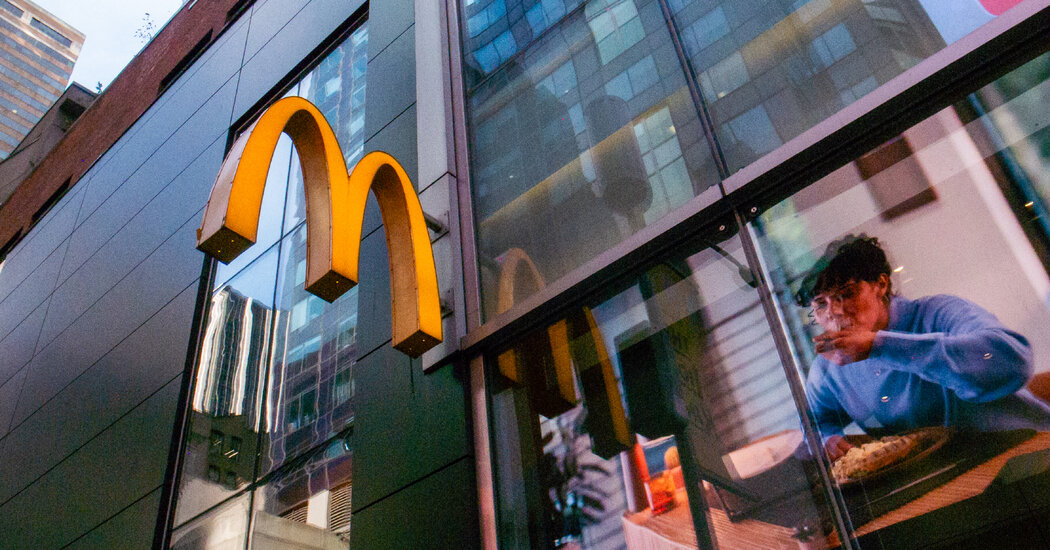
At McDonald’s, executives said while value meal offerings continued to draw customers, despite the higher fuel prices, it warned that the spending outlook was cloudy because of the war.
“What’s obviously going on is the macro environment and consumer sentiment,” Chris Kempczinski, the chief executive of McDonald’s, noted on a call early Thursday with Wall Street analysts and investors. “That’s not new news, but I think probably it’s fair to say that it’s certainly not improving and may be getting a little bit worse,” he said. “How that plays out in all of this, I think is an open question.”
The question of what sort of link there is between gas prices and consumer spending at restaurants is the subject of debate among analysts. When the restaurant data firm Black Box Intelligence examined restaurant traffic patterns and gas prices since 2017, it found that when prices exceeded $3.50 a gallon, consumers not only cut back but also traded down from sit-down dining to more fast-casual and fast-food chains.
But Peter Saleh, an analyst at investment banking firm BTIG, said in his 20 years of covering restaurants, he has seen little correlation between gas prices and restaurant traffic. “I think when gas prices climb and breach certain psychological thresholds, there could be a short-term pullback when consumers stop spending money everywhere on anything,” he said.
Instead, Mr. Saleh said the signs from the first-quarter earnings for many large restaurant chains suggested the bifurcation in consumer spending between high- and low-income households is becoming more pronounced.
Chains that have a larger higher-income consumer base, like Starbucks, reported strong sales in the quarter, while restaurants that tend to draw more lower-income households were more of a mixed bag, as that group of customers continued to spend cautiously.
In the battle for the lower-income household dollar, fast-food chains are leaning into their value meal and snack propositions. Taco Bell, which is part of Yum! Brands, reported its eighth consecutive quarter of same-store sales growth, largely because of its line of food offerings priced at $3 or less.
Likewise, McDonald’s expanded its value options in April with a new menu of items priced under $3 and a new $4 breakfast deal.
But many restaurant chains warned that continued higher fuel costs — as well as soaring beef prices — could squeeze profits and dampen consumer spending, especially among lower-income households.
Shares of Shake Shack, which also reported quarterly earnings on Thursday, plunged 30 percent in early trading to about $68. Even though its same-store sales rose 4.6 percent in the quarter from a year earlier, the company reported a loss of $290,000, on a combination of higher beef prices and investments in technology, compared with a $4.2 million profit a year ago.
On calls with analysts and investors over the past two weeks, some restaurant chains warned that higher fuel prices because of the war in Iran will likely lead to increased inflationary pressures on the restaurants and consumers later in the year.
“Obviously, based on what we know today, I think we certainly think there’s potentially inflation on the way,” toward the end of this year and into the beginning of next year, Ian Borden, the chief financial officer of McDonald’s, said on the company’s call Thursday.
Mr. Borden said the company expected inflation on restaurant food and paper products to run in the “low- to mid-single-digit range” for this year, adding that McDonald’s would be insulated from some of those increases because it had hedged a good amount of those expenses.
[ad_2]
Source link