
[ad_1]
At Gap’s headquarters in San Francisco, an archive dedicated to the apparel company’s 57-year history features nearly 6,000 boxes of memorabilia documenting the retailer’s brands, which also include Old Navy, Banana Republic and Athleta.
There are prints from photographers like Annie Leibovitz and material related to many celebrity ad campaigns, like Missy Elliott and Madonna for Gap and Cindy Crawford for Old Navy. Those dated back to the retailer’s heyday, when malls were full, celebrities wore the brand on red carpets and Gap stores were plot points in sitcoms like “Seinfeld.”
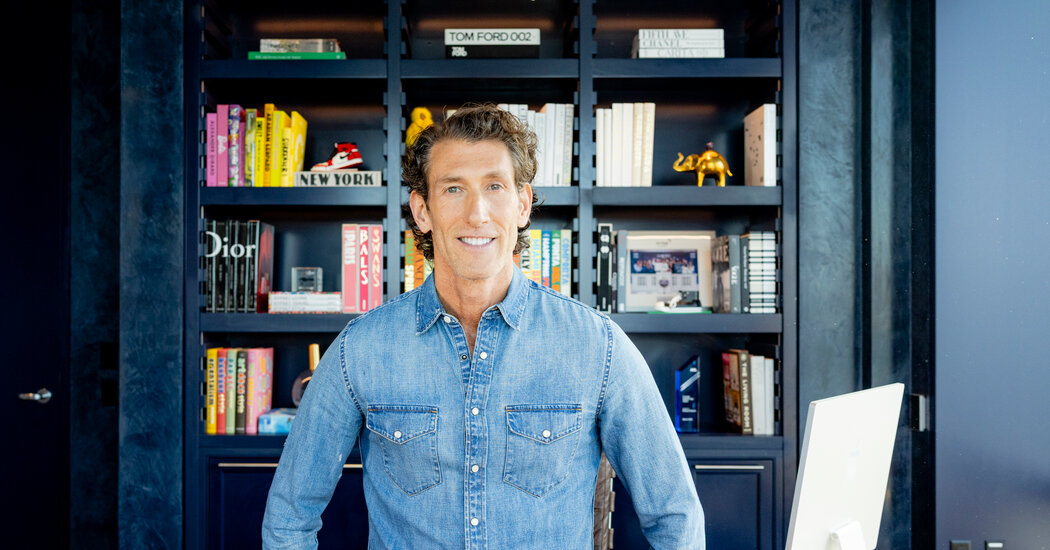
When Richard Dickson started as Gap’s chief executive nearly three years ago, he was awed by those archives and set out to change the conversation about the company.
Gap had spent years closing hundreds of stores across the United States, as sales flagged and profits were patchy. Its stock, which peaked in 2000, was languishing. The company took more than a year to fill the C.E.O. position.
Mr. Dickson, who spent nearly 20 years at Mattel, brought with him a playbook that had helped revitalize the toymaker’s brands like Hot Wheels and Barbie. He got Barbie to the big screen, with star power and a marketing machine that produced blockbuster financial results.
The native New Yorker speaks excitedly about the ways that fashion, entertainment and music are intertwined. He went to Coachella last month and has been to the Oscars in recent years. He often mentions how Gap’s first store, which opened in 1969 in San Francisco, sold records, tapes and jeans.
Mr. Dickson’s culture-focused strategy is taking root. For his creative director, he hired Zac Posen, who dressed Kendall Jenner in a Gap gown for the recent Met Gala. Gap has made toe-tapping ads featuring Katseye and Parker Posey. Mr. Dickson even hired another C.E.O. — a chief entertainment officer — to oversee the company’s push into content, licensing and Hollywood.
Gap’s comparable sales have risen for eight straight quarters, and its market value has increased to $8.5 billion, from $3.6 billion when Mr. Dickson started. Last year, Gap, Old Navy and Banana Republic posted sales increases, with only Athleta recording a decline. Gap’s namesake brand showed the strongest growth.
Mr. Dickson, 58, credits the turnaround to “being aware of pop culture, content, art, theater, music, entertainment.” If a brand makes sure that those themes come through, “you become more relevant,” he said.
This interview was edited and condensed.
As you try to bring Gap back into the cultural conversation, how are you managing your time? Are you spending more time in Hollywood?
As our business evolves, my allocated time also changes.
When I first got to the company, we were in “fix mode.” It’s no secret. My time was 100 percent spent on the operations, the financial rigor, setting up strategic priorities and editing a lot of the noise in the system that can be very distracting for a turnaround.
Over the course of three years, we’ve emerged a better company. Now we move into the next phase, which is to build momentum. My focus, while not taking my eye off the operational discipline, moves more into how to accelerate our growth.
I have a multitude of meetings and time spent with the entertainment community, which I’m very familiar with from previous roles.
When you were hired from Mattel, the chatter was that you would try to recreate the Barbie magic. Is that true, or is there a different strategy for Gap?
It’s actually the same playbook. It is not so much that the playbook is unique; it’s the methodology and the execution that’s unique.
The playbook is, first, identifying what’s our reason for being.
You could put me on any brand in the world. Why do you exist? What is our purpose? What’s our point of difference? Those simple questions have very complicated answers when you’re in a turnaround. If you can’t answer it in a sentence or two, or one or two words, you’ve got a problem.
Old Navy is different from Gap. Gap is different from Banana. Banana is different from Athleta.
So let’s focus on Gap. What makes it distinctive?
When I look at the history of every one of our brands — it wasn’t dissimilar to the Barbie conversation — what was it that broke through? What was that single thing that made it so incredibly relevant?
In our case, it was a store that was all-inclusive before inclusivity became a word, because we sold jeans for all races, all sizes, all sexes. We bridged the generation gap in the experience through music. Music was the connective tissue in the context of the store experience.
Let’s get back into that music narrative with great product storytelling and amplify it in a way that is relevant for today’s consumer. We started with Jungle with our linen campaign. We moved to Troye Sivan with a great music video around the baggy and loose trend. Then, of course, the blowout with Katseye.
These aren’t ads. Yes, you see the fleece because it looks incredible. But nobody’s saying, “Oh, my God, it’s a great deal with a great price.” They’re saying: “Did you see this? Did you feel this?” That is when you get emotional connection to a brand.
We had become more about price than product. More about stuff, not storytelling.
If you’re focusing on entertainment, how do you measure success?
We have dashboards everywhere. I think we just turned one off when you walked in because our business flashes on an hourly basis on my screens.
We have dashboards that measure brand love, people searching more for our brand and brand attributes that we test and roll out to see how consumers are feeling.
Does the focus on entertainment hedge against all of the uncertainty in the world?
To some extent, in the world that we live in, we should be that great distraction in some cases, that pleasant place that you love to go to. That ultimately makes a brand stronger, to essentially navigate more complex times. There’s always something that we have to worry about.
How worried are you about consumer spending? We’re in California right now. I passed a gas station where it was about $6 per gallon.
That was a good deal.
Most retailers say that consumers remain resilient, but are you prepared for spending levels to drop?
We have a fantastic portfolio that addresses all income cohorts.
We have quality products that should last, in some cases, for generations. You’re buying it for the long haul. But we do recognize that we need frequency: We need to stay fresh. We need to stay new.
There are a lot of businesses that will start to pull back on quality, right? We’re not.
You’re from New York City, right? Tell me about your upbringing.
My parents were both in retail, real estate and fashion. My mom was more on the creative side, and my dad was more on the financial and operations side.
My grandparents were also in fashion and retail. They were Holocaust survivors. My grandmother sewed and had her own line in department stores. My grandfather ran the factory, so they had a small business that did very well. I remember growing up and running around the factory floor.
What’s a piece of advice that you received that you still reflect on today?
Retail is detail. There’s not a single day where everything goes right, but at the end of that day you could still say that it was a great day.
Ultimately you’re firefighting on a minute-to-minute basis. You’re constantly in motion. That sense of detail orientation is probably an attribute that’s carried with me from my earliest days in the industry.
It’s time for the lightning round. What’s on heavy rotation on your music playlist right now?
Who I really like right now is Sombr. I saw him at Coachella.
What’s the last thing you asked A.I.?
To decipher an object that somebody sent me from a museum and I wanted to know which museum it was from.
How often do you check Gap’s stock price?
I probably check it twice a day. I do a morning check and at the end of the day.
When you need to feel most confident, what are you wearing?
I love our hoodies, and not only our fleece hoodies at Gap but Banana Republic’s cashmere hoodie. Depending on the vibe, I would go with a fleece or cashmere hoodie. Then I usually throw on a Banana Republic trucker jacket.
I wear all of our brands. I have worn a few sweatshirts from Athleta.
If you had to explain each of your brands in exactly one word, what would it be? Let’s start with Old Navy.
Family.
Gap?
Individuality.
Banana Republic?
Adventure.
Athleta?
I’m going to go with empowerment.
[ad_2]
Source link
Шукав рідкісну прокладку карбюратора і несподівано натрапив на неї в каталозі. Виробника уточнюю ще до оплати, щоб не купувати ту саму деталь двічі. Якось замовив сальники вилки навмання, а потім довелося міняти на потрібні. Окуляри-маску брав на розпродажі й заплатив менше, ніж торік. Консультант підбере деталь за моделлю мотоцикла, навіть якщо номер на корпусі вже не читається. Реєстрація не обов’язкова, тому замовлення займає буквально хвилину. Дрібні запчастини перемотують плівкою, тож усередині нічого не бовтається. Повертаюся сюди не вперше, бо про наявність і терміни кажуть чесно, без вигадок. Під мотоекіпірування там виділили розділ із захистом – мотокуртки, наколінники, рукавички. Наколінники багато хто відкладає на потім, хоча під час падіння дістається саме колінам.