
[ad_1]
On the evening of Thursday, June 12, a small group of internet gamblers made a highly specific prediction on Polymarket, the betting website that offers odds on virtually everything.
Thirteen users wagered a total of $140,000 that Israel would strike Iran by the end of that week, even as the odds suggested that an attack was unlikely. Seven of the accounts had been opened just days earlier. Another had a history of bets related to military action against Iran — and had won money on all of them.
Israel attacked Iran later that day, netting the accounts more than $600,000 in profits.
The explosive growth of prediction markets like Polymarket has rattled the political world over the last year, fueling concerns about a new kind of insider trading by military leaders and government officials with access to confidential plans. A military reservist was recently indicted in Israel for a scheme to bet on the June strike, while a U.S. Army Special Forces soldier was accused last month of wagering on the capture of Nicolás Maduro, the president of Venezuela.
Those bets represent only a slice of the suspicious activity on Polymarket. A New York Times examination found that more than 80 Polymarket users have placed bets with suspicious characteristics, including 38 whose well-timed wagers have drawn little or no public attention. They won money across nearly 30 topics dating back to at least 2024, from Israel’s strike on Iran last year to the regulatory debate over cryptocurrency trading.
The Times’s examination also revealed previously unreported red flags in some of the high-profile bets that have drawn scrutiny. The findings were based on a series of warning signs that hint at insider trading without proving it definitively. Those signals include long-shot bets that pay off, well-timed wagers by recently opened accounts and bets by users who gamble on only a few related topics without ever losing, among other considerations.
The Times identified more than 11,000 Polymarket accounts that exhibited some combination of those characteristics, then manually reviewed the most striking cases, comparing the users’ trading histories against overall prediction market activity. Many of the examples involved military operations, which have attracted a surge of betting this year.
While the accounts The Times examined make up a small portion of Polymarket’s users, they show how suspicious wagers can unfold on the site and highlight the vulnerability of prediction markets to manipulation. Polymarket’s trading data is publicly visible, which makes it possible to reconstruct betting patterns with second-by-second accuracy.
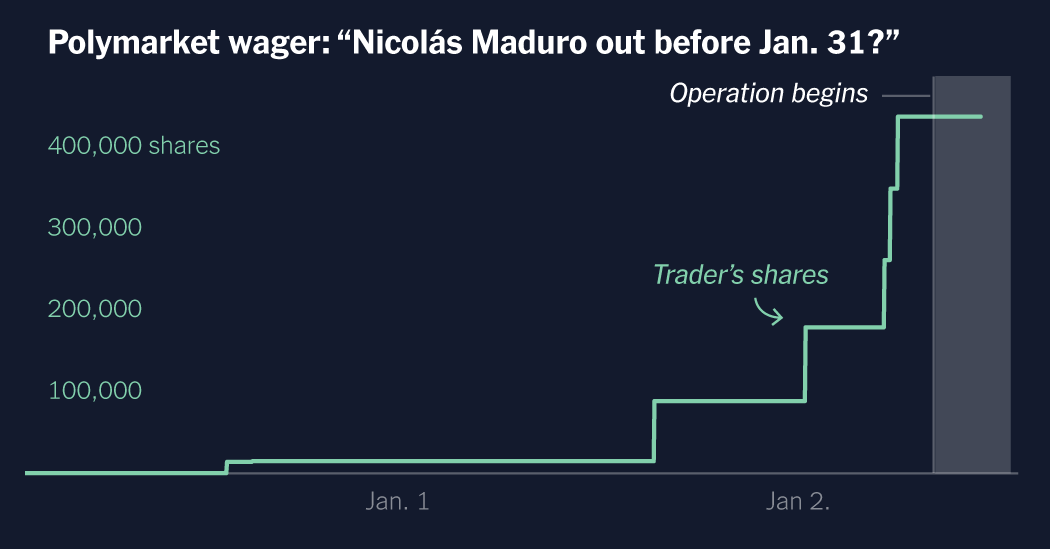
One of the highest-profile cases occurred at the start of the year, when the idea that Mr. Maduro would soon be ousted as Venezuela’s leader seemed unlikely. The odds on Polymarket reflected that doubt, sitting at around 7 percent. Then something unexpected happened: The United States swept into Venezuela on Jan. 3 and arrested Mr. Maduro.
Somehow, one user appeared to know the arrest was coming. The account had placed large bets on Jan. 1 and Jan. 2 predicting that Mr. Maduro would be “out” as Venezuela’s leader before the end of the month. When Mr. Maduro was captured on Jan. 3, the user pocketed more than $400,000. Prosecutors later charged Master Sgt. Gannon Ken Van Dyke, the special forces soldier, with using classified information to make that bet.
A similar betting pattern played out when Polymarket offered odds on whether the United States would announce a cease-fire in the war with Iran by April 7.
At least seven users placed bets in the hours before President Trump announced the agreement in a Truth Social post on April 7. Collectively, they won more than $1.4 million, including two users who each walked away with over $400,000 in profits.
The Times also found warning signs in areas unrelated to America’s foreign policy. In 2024, a user created a Polymarket account and placed a single long-shot bet that a financial product tied to the cryptocurrency Ether would be approved by the Trump administration. A month later, the user withdrew $50,000 in profits after regulators blessed the product.
Based on the public data alone, it is impossible to conclude whether these users were insiders who had access to nonpublic information. Many sophisticated bettors use automated bots to place well-timed wagers that may appear suspicious at first glance, while some prediction market traders pride themselves on making giant bets against the odds that occasionally pay off.
But The Times’s examination adds to evidence suggesting that Polymarket has been exploited by users with information that is not publicly available.
Last month, the nonprofit Anti-Corruption Data Collective released a report about Polymarket that found heavy bettors on underdog outcomes — an event with at most a 35 percent likelihood — won more than half the time on topics related to the military, calling it a sign of “potential insider trading.” Similar wagers on other topics were profitable only 14 percent of the time, the report found.
Polymarket has pledged to combat insider trading, saying it has “no place” on the platform. A company spokeswoman said the firm “continuously monitors its markets for suspicious activity and regularly engages with relevant authorities when appropriate.”
Polymarket and its main rival, Kalshi, are the most popular prediction markets. But they differ in important ways. Polymarket’s main platform processes wagers in crypto, creating a public record of transactions. Much less data is available about the bets on Kalshi, which announced in February that it had opened more than 200 insider-trading investigations resulting in over a dozen “active cases.”
Robert DeNault, Kalshi’s head of enforcement, said in a statement to The Times that insider trading was banned on the platform. “We surveil, investigate and punish it,” he said.
Coordinated Activity
For years, prediction markets occupied a legal gray area in the United States. A tiny financial agency, the Commodity Futures Trading Commission, barred Polymarket from serving U.S.-based customers in 2022, while Kalshi battled those regulators in court for authorization to offer bets on congressional elections.
Now the landscape is shifting in these firms’ favor.
Kalshi won its case in October 2024, paving the way for election betting in the United States. Within a year, Polymarket secured regulatory approval to start offering some services, though the majority of its betting markets, including wagers on military action, are still available only overseas. Sergeant Van Dyke gained access to the website using a virtual private network, a tool that disguises a user’s location, according to court papers.
Together Kalshi and Polymarket draw $25 billion in monthly trading volume, up from less than $2 billion a year ago, an explosion of popularity that poses a challenge to regulators.
Under federal law and agency regulations, insider trading on prediction markets is prohibited, though what qualifies as an offense is a complex legal question. Some advocates for the sites argue that certain insiders can help generate more accurate forecasts, making prediction markets a useful source of information.
In a CBS “60 Minutes” interview last fall, Shayne Coplan, Polymarket’s chief executive, called insider trading “an inevitability” that comes with “a lot of benefits,” while stipulating that trading platforms need to draw an ethical line somewhere.
“What’s cool about Polymarket is that it creates this financial incentive for people to go and divulge the information to the market,” he said at an Axios conference in November. “Or someone tells someone, and then the market responds.”
But potential insider activity does not always create a clearer picture for the public, The Times found. Someone with insider knowledge can employ a range of strategies to accumulate large, profitable positions without moving the needle on the odds.
In January 2025, a Polymarket user who regularly wagered on Washington politics began betting that President Joseph R. Biden Jr. would pardon his brother James Biden. The user placed 53 separate bets worth more than $20,000, even as the odds declined.
Less than 40 minutes after the user’s final bet on Jan. 20, the White House announced that Mr. Biden had signed a last-minute pardon for his brother. The user earned $200,000, cashed out and has not bet since.
The Times’s review also found possible coordination among Polymarket accounts that placed bets at identical times. Such activity can signal that an individual user deployed automated bots to avoid detection, obscuring a large position across many accounts.
A possible example emerged on Feb. 27, when Mr. Trump at 3:38 p.m. gave the order to strike Iran while he was aboard Air Force One. Over the next few hours, at least 27 accounts placed thousands of dollars of simultaneous bets predicting that the United States would attack by Feb. 28. When the strike began around 1 p.m. on Feb. 28, the accounts collected profits of more than $700,000.
Much of the suspicious activity has been concentrated on the conflicts in the Middle East. Of the 27 betting topics that The Times flagged, 12 focused on the U.S.-Israeli war with Iran.
In February, Israeli authorities charged the military reservist with using nonpublic information to help an accomplice make more than $100,000 betting on Polymarket about the timing of Israel’s attacks on Iran and Yemen.
“It’s happening now,” the soldier texted his accomplice, just as military planes took off for the June attack, according to the indictment.
In court this month, the reservist’s lawyer argued that his client’s unit in the Israeli Air Force had a penchant for gambling, a risk-taking impulse that was common in the military.
An Israeli military representative said the defense forces had taken steps to “strengthen oversight and control systems” since the Polymarket bet was exposed.
Political Ripples
The rise of suspicious trading has caused alarm in Washington.
The Senate passed a resolution last month barring senators and their staff members from using prediction markets. In April, Mr. Trump said he was “never much in favor” of the sites and lamented that “the whole world unfortunately has become somewhat of a casino.”
Within days, he reversed himself, noting that people working in the prediction business are “pretty happy with it.” Mr. Trump’s eldest son, Donald Trump Jr., is an adviser to Kalshi and Polymarket, and the family’s social media company, Trump Media, has announced plans to offer a prediction market.
The scrutiny on prediction markets has put a spotlight on the Commodity Futures Trading Commission. Historically, the agency has overseen markets for oil, agricultural goods and certain financial instruments known as swaps. Because prediction market bets are classified as swaps, the agency has argued, the sites fall under its purview as well. But the C.F.T.C. has a relatively small staff and a spotty record of enforcement that has drawn skepticism from critics.
Michael Selig, the agency’s chairman, is an outspoken prediction market enthusiast who has hopscotched the country giving speeches about the technology’s potential to rival traditional media as an information source.
“It’s really important that we protect these markets here in the U.S.,” he said at a crypto conference in March.
In a statement to The Times, Mr. Selig said the agency had a “renewed focus on efficiency” and was using artificial intelligence to bolster its capabilities. “There are no gaps in our ability to fulfill our mission,” he added.
As concerns have intensified, Polymarket has promised to monitor for misconduct. But its public pronouncements are sometimes contradictory.
Three weeks before the Special Forces soldier was indicted, Mr. Coplan, Polymarket’s chief, was interviewed at Harvard Business School, where he was asked about suspicious activity in the Maduro betting market.
“For the Maduro one, it’s actually a very funny story — it’s not what it seems,” Mr. Coplan said. “It’s just more of a fluke than it is some sort of exciting thing.”
Once the federal charges were announced, Mr. Coplan told a different story, writing on social media that Polymarket had “flagged this, referred it, and cooperated throughout the process” with the Justice Department.
In April, Kalshi said it had unearthed three examples of insider trading — all congressional candidates who had placed bets on their own races.
In one case, Kalshi said, a Democratic candidate for U.S. Senate in Virginia placed a bet that he would join the race, a decision he clearly controlled. Kalshi fined him more than $6,000 and gave him a five-year ban from the platform.
Because prediction market data is public, the hunt for insider trading has also become a social media phenomenon.
On X, users post screenshots of prediction markets with strange patterns or bets from new accounts. Some traders have built strategies around identifying insiders and then copying suspicious wagers before other bettors catch on.
One market that was flagged on social media centered on a prominent internet sleuth, who announced in February that he was preparing a detailed investigation into an unnamed crypto company whose employees had “abused internal data.”
Speculators on Polymarket started betting on who the sleuth’s target might be. Between Feb. 24 and Feb. 26, an anonymous user who had just joined Polymarket bet more than $65,000 that it was Axiom, a crypto trading firm. (Axiom did not respond to a request for comment.)
The wager was correct. On Feb. 26, the sleuth accused Axiom employees of insider trading.
It’s unclear who made the bet. The sleuth said that he had been “retained” to investigate Axiom, and that he had reached out to the firm before posting his findings.
The anonymous bettor walked away with $411,647 in profits.
Johnatan Reiss contributed reporting.
[ad_2]
Source link


купить мед справку спб где сделать справку в спб
Blue sky sparkles https://karfaoqer.com
Все самое свежее здесь: https://perfumerio.ru/s/christian-dior-miss-dior-cherie-eau-de-parfum/
размеры профильных труб размеры профтрубы
Закажите G202 https://mismar74.ru/G202.html онлайн. Актуальные цены, наличие на складе, технические характеристики, выгодные условия покупки и быстрая доставка по всей России.
Пройдите комплексное лечение https://medprime-clinic.ru и диагностику в медицинском центре. Полный спектр обследований, консультации профильных специалистов, современные методы лечения, контроль состояния здоровья и индивидуальный подход на всех этапах медицинской помощи.
Главный материал дня: https://razrabotka-dokumentov-ohrana-truda.ru
Узнайте на blok-pitaniya-i-led-lenti.netlify.app, чем отличается блок питания от LED-драйвера и как правильно выбрать источник питания для светодиодной ленты.
Подобное решение помогает избежать чрезмерного нагрева и преждевременной неисправности устройств.
### Раздел 2. Выбор оборудования
Выбор блока питания выполняют после расчёта длины и энергопотребления ленты.
### Раздел 3. Подключение и безопасность
Устанавливать оборудование необходимо только после отключения электропитания.
### Раздел 4. Практическая польза сайта
В результате планирование проекта проходит организованнее и понятнее.
Discover more about oral care at prodentin for teeth and see what makes it stand out.
The site focuses on practical information that helps visitors make sense of daily care.
## Section 2
If the content is simple to follow, people can focus on the details that matter most.
## Section 3
A clean presentation can encourage visitors to stay longer and explore further.
## Section 4
For anyone exploring oral wellness online, prodentim2026us.netlify.app can serve as a focused starting point.
Инструменты ответственной игры Казино Вавада включают лимиты депозита, ограничение времени сессии и период охлаждения. Витрина трендов показывает автоматы, набирающие популярность у аудитории площадки за последние семь дней. Инструкция по входу размещена здесь: https://indodarts.com Такая работа с сообществом формирует ощущение живого проекта, где обратная связь влияет на продуктовые решения.