

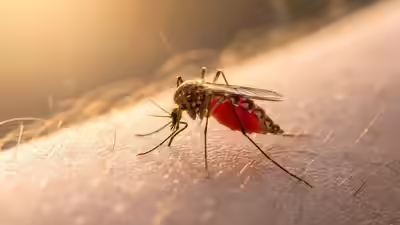
Spring marks the start of mosquito activity in many regions, particularly in the United States. For decades, researchers have studied why certain people seem more prone to mosquito bites than others. A recent study published in ScienceAdvances provides detailed insights into the behaviour of one of the most common species, Aedes aegypti. The research examined how these mosquitoes use environmental cues, such as visual contrast and carbon dioxide, to locate hosts. Understanding these mechanisms is essential for developing more effective control methods. The study also provides data on the specific patterns mosquitoes follow when approaching potential hosts.
How mosquitoes use visual and chemical cues to find humans
According to the study published in ScienceAdvances, titled ‘Predicting mosquito flight behaviour using Bayesian dynamical systems learning,’ explains how mosquitoes use a combination of sensory inputs to identify targets. Visual contrast is a primary factor. Experiments have shown that dark surfaces are more easily detected than lighter ones. However, visual information alone is not sufficient to consistently attract mosquitoes. Chemical cues, especially carbon dioxide exhaled by humans, are also critical. Carbon dioxide serves as a long-range signal, guiding mosquitoes toward potential hosts. When combined with high-contrast visuals, the attraction is significantly stronger. Researchers at Georgia Institute of Technology conducted three controlled experiments in a specialised chamber. The chamber contained hundreds of mosquitoes and was monitored using 3D infrared cameras to track flight trajectories. Initial tests involved simple objects: black-and-white spheres. Observations indicated that mosquitoes showed minimal engagement with single-colour spheres unless a chemical signal was present. The addition of carbon dioxide produced a measurable increase in targeting behaviour. In particular, the combination of black objects with carbon dioxide generated the highest approach frequency.
How mosquitoes target humans without following each other
To confirm the interaction of visual and chemical cues, one of the researchers, Christopher Zuo, participated as a human subject. He wore outfits in three variations: all black, all white, and a split black-and-white design. Mosquito swarming patterns were recorded around his body. Analysis showed that the majority of activity was concentrated around the head and shoulder regions, corresponding to areas with higher carbon dioxide emission and heat output. The results reinforced the conclusion that mosquitoes respond to independent sensory cues rather than following each other. Individual insects approach based on direct detection of signals, not collective behaviour.Data analysis conducted at the Massachusetts Institute of Technology indicated that mosquitoes do not coordinate movement when approaching hosts. Each insect independently detects and responds to visual contrast and chemical emissions. This rule-based behaviour creates the appearance of group coordination without actual interaction. The study compared mosquito movement to simple algorithmic patterns, showing predictable trajectories based on sensory inputs.
Practical strategies to reduce mosquito bites and exposure
- Wearing lighter clothing – Dark colours attract mosquitoes more, so lighter clothes may make you less visible to them.
- Limiting chemical attractants – Reducing strong scents from perfumes, lotions, or sweat can lower attraction.
- Using sensory-disrupting devices or traps – Traps that emit carbon dioxide or light intermittently can lure mosquitoes more effectively without constant exposure.
- Minimising prolonged outdoor exposure in high mosquito activity areas, especially during peak times like dusk and dawn.










Leave a Reply