
[ad_1]
Apple will have a new chief executive in September, after 15 years with Tim Cook as its leader. In the meantime, it was business as usual for the company, which on Thursday reported another quarter of strong sales and profit.
Apple’s revenue for the three months ended in March rose 17 percent from a year earlier to $111.2 billion. Profit jumped 19 percent to $29.6 billion, breaking its record for the quarter, which was set in 2022.
Apple reported results just over a week after announcing a transition in its corner office. Last week, the company said Mr. Cook, 65, would step down and become its executive chairman in September. John Ternus, 50, most recently its head of hardware engineering, will succeed him.
The changing of the guard comes at a financial high for Apple. The company has continued to enjoy the popularity of its redesigned iPhones, which debuted in September, even as other consumer electronics companies struggle with a global shortage in memory chips.
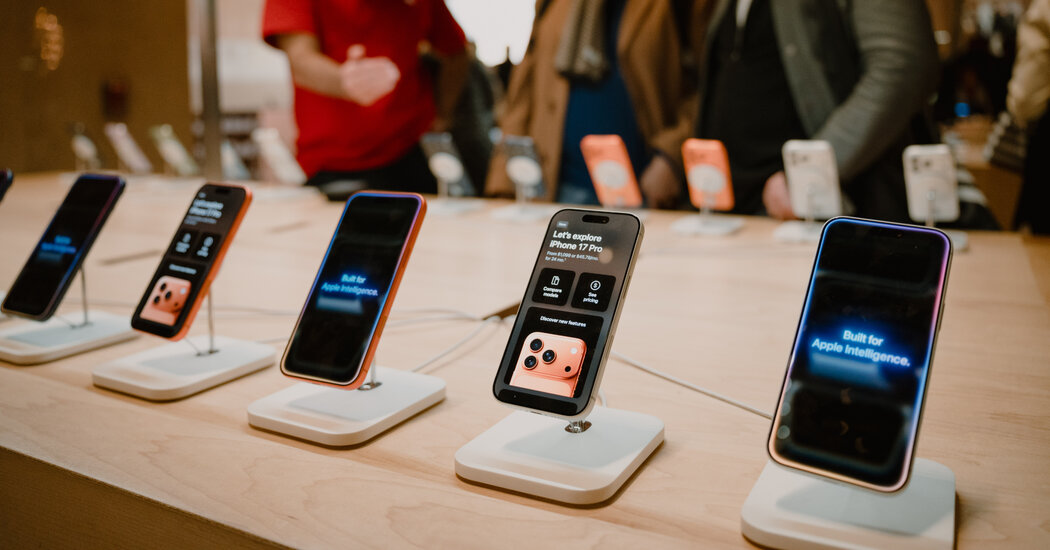
Last year, Apple introduced new designs for the iPhone: a thin model called the iPhone Air and a model of the iPhone Pro with a raised bump across the back for cameras. It also increased the prices of some iPhones by $100. Those changes have buoyed iPhone sales, which grew 22 percent to $57 billion.
The new designs have also helped Apple rebound from years of weak sales in China, the world’s largest smartphone market.For the first three months of the year, Apple’s sales in China grew 28 percent to $20.5 billion.
Apple’s results topped expectations. Wall Street analysts had predicted quarterly revenue of $109.46 billion and profit of $28.52 billion.
“Apple just continues to modestly exceed expectations,” said Daniel Newman, the chief executive of Futurum Group, a technology analysis company. “Clearly, the phone is a franchise, and it’s going to continue to have strong results.”
But, Mr. Newman added, the artificial intelligence boom has made a longstanding question even more urgent for Apple: “Is there some format, some product in the future, that’s going to come and displace the phone?”
Apple has largely stayed out of the A.I. scrum after stumbles last year. While its peers are spending hundreds of billions of dollars on developing and running the technology, Apple has slowly introduced A.I. features and worked with other companies, like Google. In January, Apple said it would use Google’s Gemini A.I. models to power its A.I. products, including the personal assistant Siri.
A.I. is complicating parts of Apple’s business. In recent months, memory chips have become scarcer and more expensive because of increased demand from A.I. chipmakers like Nvidia and Advanced Micro Devices. So far, the shortage hasn’t cut into Apple’s margins.
“They have size and scale, and no one is turning Apple down,” said Stephanie Link, the chief investment strategist at Hightower Advisors, a wealth management firm. “The problem is, there’s just not enough of it,” she added, referring to memory chips.”
Apple’s services revenue grew 16 percent to $31 billion in the first three months of the year. The company saw more modest growth in sales of Macs, iPads and wearables, which include the Apple Watch and AirPods.
[ad_2]
Source link


Пройдите комплексное лечение https://medprime-clinic.ru и диагностику в медицинском центре. Полный спектр обследований, консультации профильных специалистов, современные методы лечения, контроль состояния здоровья и индивидуальный подход на всех этапах медицинской помощи.
Эксклюзивные подробности: https://6may.org
Обновлено сегодня: разработка инструкций по охране труда нормативный документ