[ad_1]
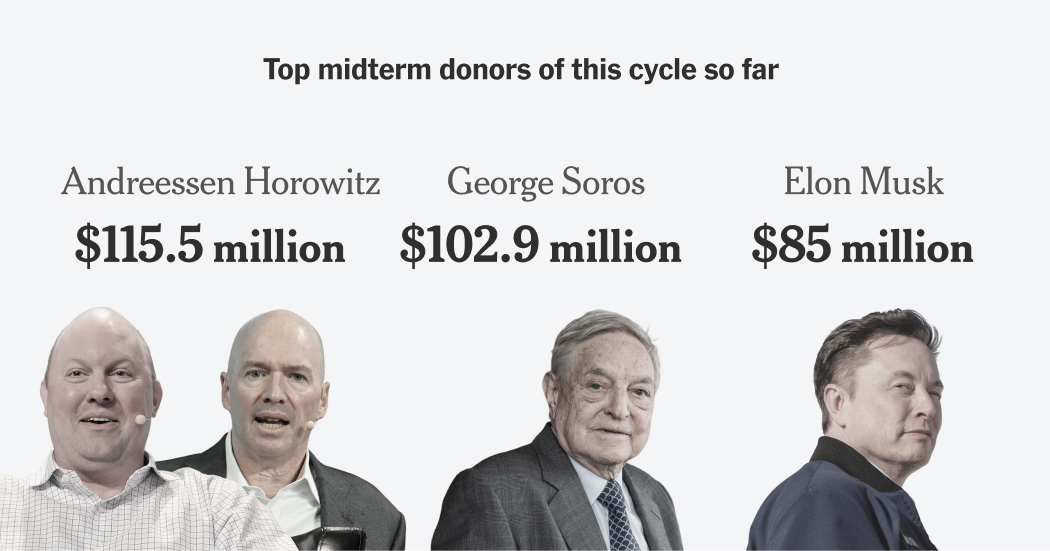
The biggest donor in the midterm elections is not Elon Musk, or George Soros, or any of the other billionaires who are often thought to wield the fattest wallets in politics.
It is a venture capital firm: Andreessen Horowitz.
The Silicon Valley firm, along with its lead partners who have their names on the door, Marc Andreessen and Ben Horowitz, have funneled more than $115 million so far in disclosed federal contributions to midterm election efforts, according to a New York Times analysis. That makes it the biggest known spender on this campaign cycle.
Andreessen Horowitz is not new to politics. Its founders are billionaires and experienced donors. But the amount of zeros on its checks has increased beyond even the $63 million or so that it and its eponymous founders spent in the 2024 cycle, as part of an astonishing effort by an investment shop to bend politics to its will.
Its unusual role in this election cycle immediately became clear after the last one. The day after Election Day — with no major elections to be held for another two years — is not typically when eight-figure donations are made. But on Nov. 6, 2024, Andreessen Horowitz officially pumped more than $23 million into the cryptocurrency industry’s main super PACs, underscoring that its political commitment was long term and not a passing interest.
Andreessen Horowitz declined to comment and did not make Mr. Andreessen and Mr. Horowitz available for interviews.
“My conclusion is this has to be a permanent role that we play,” Mr. Andreessen said on an election recap podcast recorded a few days later. “There will be some phases of the moon in which the tides are on our side. And there will be some phases when we really have to fight. But we have to stay involved every step of the way.”
The venture firm’s spending is part of a shift. In this year’s midterms, the biggest donors are no longer individual billionaires but corporations like Andreessen Horowitz, which critics said could overwhelm elections to push a pecuniary interest.
Already Andreessen Horowitz has put $47.5 million into the crypto super PAC network, Fairshake, since Election Day 2024. And the firm’s interests have expanded beyond crypto. It helped found Leading the Future, a super PAC network focused on electing pro-artificial intelligence legislators, which is modeled on Fairshake, and donated $50 million to it. Fairshake and Leading the Future both back Republicans and Democrats.
Andreessen Horowitz and its co-founders have also together donated $12 million to MAGA Inc., President Trump’s super PAC, including $6 million in March. A trust linked to Mr. Andreessen donated nearly $900,000 to the Republican National Committee that same month.
All of this has helped Mr. Andreessen, in particular, cultivate a close relationship with the Trump administration.
Before Mr. Trump took office for his second term last year, Mr. Andreessen spent “half” his time at Mar-a-Lago helping with the transition, he has said. The venture capitalist also informally advised Mr. Musk’s Department of Government Efficiency. And two former Andreessen Horowitz partners took on senior government jobs, including one working on A.I. regulation.
In March, Mr. Andreessen, 54, was named to an elite White House tech council. He was recently invited to attend the state dinner thrown for Britain’s King Charles, and to a White House dinner for Mr. Trump’s so-called Rose Garden Club, where the Rose Garden’s lawn was paved over.
Technically, Mr. Andreessen’s and Mr. Horowitz’s donations have largely come from their firm, which they own, according to regulatory filings. The approximately $115 million that Andreessen Horowitz has spent on this election cycle does not include millions that the firm recently put into a new advocacy nonprofit it helped start on A.I. issues, American Innovators Network, which is not required to disclose donations.
Founded in 2009, the firm has been among Silicon Valley’s most venerated investment entities. It modeled itself on Hollywood talent agencies to invest in start-ups, with aggressive hiring and a knack for self-promotion. Early investments in the crypto exchange Coinbase and the photo-sharing app Instagram helped build its reputation.
Its co-founders have colorful histories in politics. After striking fame and fortune in the 1990s as the wunderkind founder of Mosaic, one of the earliest internet browsers, Mr. Andreessen became a key member of Vice President Al Gore’s “Gore Tech” brain trust and a workhorse Democratic fund-raiser.
Over the years, he drifted right. After Mr. Trump won the 2016 presidential election, Mr. Andreessen “deliberately withdrew from political engagement and fund-raising,” he has said. He went on a “spirit walk” through the political system, he said on a podcast, where he tried to “reread everything from scratch” with a focus on ideological extremes.
Mr. Andreessen is known for being hyperactive in private group chats, where he now regularly engages with conservative activists about the news of the day, people with knowledge of his messages said.
Mr. Horowitz, 59, is the son of a conservative rabble-rouser, David Horowitz, but is less politically outspoken and less involved in the firm’s super PACs, a person close to the firm said. The firm endorsed Mr. Trump in the summer of 2024, but that October, Mr. Horowitz also financially backed Kamala Harris, the Democratic presidential candidate, based on his friendship with her.
Mr. Andreessen and Mr. Horowitz have said they are “single-issue voters,” casting ballots purely on what is good for tech start-ups. They were catalyzed after skirmishes with the media and with Biden administration officials on tech policy, people who have talked politics with them said.
Mr. Andreessen has told friends a story about a confrontation he had about a decade ago with David Remnick, the editor of The New Yorker, at the headquarters of Condé Nast, which owns the magazine. Mr. Remnick’s team argued that the tech elite were out of touch, a person who heard Mr. Andreessen’s version of the story said, but when the investor saw how well appointed the Condé Nast offices and bathrooms were, he concluded that it was the media elite who were out of touch.
Before the 2024 election, Chris Lehane, a prominent Silicon Valley political operative who is on the board of Coinbase with Mr. Andreessen, began organizing what became Fairshake. Mr. Andreessen and Mr. Horowitz have said the Biden administration was too hostile to crypto, where Andreessen Horowitz has many investments. They wanted to chart a new path politically for crypto after the fraud conviction of Sam Bankman-Fried, the crypto entrepreneur who had been a political leader for the industry.
So Andreessen Horowitz and crypto companies like Coinbase and Ripple agreed to become Fairshake’s anchor donors; the venture firm sent $47 million that election cycle to Fairshake. The effort was seen as a success, though much of today’s pro-crypto policy in Washington stems from Mr. Trump, whom Fairshake did not support.
In spring 2025, Mr. Lehane, now an OpenAI executive, was part of a group that consulted with Andreessen Horowitz, tech donors and political operatives on repeating the same campaign-finance strategy, but starting earlier, with the A.I. industry.
Andreessen Horowitz, which has extensive A.I. investments, was all in. The firm sent $25 million to Leading the Future in August and $25 million more in February. It has not decided on further donations to either group, people close to the firm said.
Andreessen Horowitz’s $115 million or so in political donations is small compared with its $100 billion in assets under management. Still, its venture capital rivals, such as Sequoia Capital and Founders Fund, have done nothing of the sort.
In aggregate, the next biggest disclosed federal donors since the 2024 election are entities tied to Mr. Soros, at about $103 million, and Mr. Musk, at $85 million, according to The Times’s analysis.
Andreessen Horowitz’s political posture has led to some backlash.
Internally, one of the firm’s earliest partners, John O’Farrell, resigned from his part-time advisory role last May over political differences, according to a person who spoke to him. He has criticized Leading the Future and Fairshake, along with what he has called “eager tech enablers of this regime, including some of my former V.C. friends and partners.” He declined to comment.
Outside the firm, progressives have attacked Andreessen Horowitz. Last year, some Democrats admonished Senator Ruben Gallego, Democrat of Arizona, for holding a fund-raiser with Mr. Andreessen.
Andreessen Horowitz’s support of Leading the Future has specifically attracted scrutiny. A competing super PAC focused on A.I. safety, Public First, was started in reaction to the spending by Andreessen Horowitz and its allies, so much so that some organizers joked about naming Public First “z16a,” an inversion of a nickname commonly used for Andreessen Horowitz, “a16z.”
Alex Bores, a Democratic state legislator running for Congress in New York, whom Public First has backed, said he relished the attacks he faced from Leading the Future.
“Venture capital is all about achieving scale as quickly as possible, but I don’t think you should apply that to buying our democracy,” Mr. Bores said.
Some Republicans are not enthused with Andreessen Horowitz’s political bets, either. They are privately frustrated that Fairshake and Leading the Future insist on bipartisanship, believing the PACs should align with the Republican Party given the party’s generally friendlier positions on A.I. and crypto.
Mr. Andreessen and Mr. Horowitz have told allies that they have limited decision-making power in the PACs. They rarely interact with the PACs’ leadership directly, people with knowledge of the dynamics said.
Andreessen Horowitz’s political strategy and Washington lobbying are guided by Collin McCune, a Republican and former Capitol Hill aide. He is regularly briefed on moves by the two super PACs and keeps Mr. Andreessen and Mr. Horowitz abreast of developments.
That does not mean Mr. Andreessen does not know how the game is played.
“If you think there’s a lot of money in politics now,” he said as a 29-year-old in 2000, “you haven’t seen anything yet.”
[ad_2]
Source link