
[ad_1]
The contract has been signed and the down payment made. But the buyers of a new Super Duty F-250 pickup truck keep waiting — and waiting and waiting —to drive it off a Ford dealer’s lot in Kansas.
Not because of supply-chain issues or custom options that are difficult to find.
This particular vehicle, a King Ranch edition that costs about $90,000, has more than 500 horsepower in its engine, a “concert-quality” Bang & Olufsen sound system, two-tone paint trim and 34-inch Bridgestone tires.
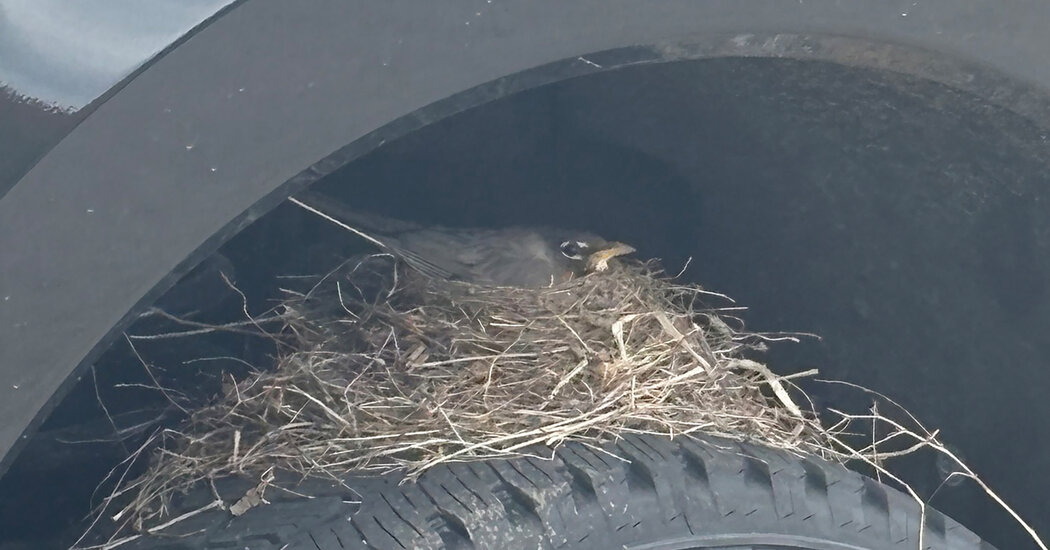
But it’s most notable feature is the nest resting on top of the front passenger-side tire where four robin chicks are maturing.
An employee at Olathe Ford outside Kansas City, Kan., discovered the nest a few weeks ago, said Sammi Dodson, the dealership’s marketing manager.
There were four distinctive blue robin eggs, then not yet hatched.
“These birds know how to pick ’em,” Ms. Dodson said in an interview of the nesting site.
She consulted the internet about what to do.
Ms. Dodson learned that most bird nests, including those of robins, are federally protected under the Migratory Bird Treaty Act, which makes it illegal to destroy or interfere with a nest that has eggs or chicks in it.
She called Operation WildLife, a wildlife rehabilitation center serving northeast Kansas, for help.
Diane Johnson, the center’s executive director and a registered veterinary technician, said the group advised the dealership that if the truck’s buyers were getting antsy, the nest could be moved to the tire of another pickup truck that was similar.
There was one parked right next to it.
The buyer, who the dealership said was a construction company that did not want to be publicly named, was content to let nature run its course.
“The new owners said they were in no hurry to get the truck and the robins could finish raising their family,” Ms. Johnson said.
It takes about four to six weeks for robin eggs to hatch and for fledglings to leave the nest, said Ms. Johnson, who noted that robins often build their nests in trees.
Sometimes, they select the space where gutters on homes meet downspouts or alcoves for their nests, which are made of mud and grass, she said.
“They do like to keep their nests dry,” said Ms. Johnson, who has been caring for animals for about 40 years. “This one was a new one.”
On May 14, the eggs hatched, which the auto dealership dutifully chronicled on social media.
“They should be getting ready to take flight,” Ms. Dodson said. “The look like full-grown birds now.”
On the traditional windshield sign the dealership displays on a car to show it was sold, Olathe Ford listed the customer’s name as “ROBIN.”
For the date of expected delivery, it added, “TILL THEY FLY.”
[ad_2]
Source link


Деталей вистачає не лише на планове обслуговування, а й на серйозний ремонт двигуна. Мастила і фільтри беру лише оригінальні, бо підробка шкодить двигуну більше за будь-які навантаження. Найпростіше скинути VIN або номер рами, щоб підбір був точним з першого разу. Порівнював вартість комплекту гуми в кількох магазинах, і найвигідніше вийшло саме тут. Уточнював у листуванні, який розмір черепахи брати, і отримав чітку пораду замість відписки. Номер деталі вбиваєш прямо в рядок пошуку, і назву товару вгадувати не треба. Дрібні запчастини перемотують плівкою, тож усередині нічого не бовтається. Ставлення до покупця людське, за кожним замовленням пояснюють, що і коли приїде. Сайт називається zapchasti-na-motocikl.dp.ua, це магазин запчастин для мотоциклів. Зовнішня схожість деталі ще нічого не гарантує, звіряти треба кріплення і посадкові розміри.
Багато позицій, на які деінде доводиться довго чекати, тут просто лежать на полиці. Відвертого мотлоху серед деталей не траплялося, постачальників відбирають ретельно. Габарити в описі допомагають звірити деталь ще до замовлення. Порівнював вартість комплекту гуми в кількох магазинах, і найвигідніше вийшло саме тут. Написав у чат із фото деталі, відповіли швидко і по суті. Пошук одразу за своїм мотоциклом виручає, коли гортати весь каталог немає бажання. Післяплата доступна, тому оглянути деталь можна ще до оплати. Повертаюся сюди не вперше, бо про наявність і терміни кажуть чесно, без вигадок. Адресу тримай – https://zapchasti-na-motocikl.dp.ua, мотозапчастини там шукати зручно. Розмірну сітку кожного бренду дивлюся окремо, бо в різних виробників однакова літера означає різне.