
[ad_1]

A sharp reversal is now underway in US migration trends, with 2025 marking a significant slowdown in net immigration after the record surge of the previous year. Estimates from the Brookings Institution suggest that net migration has fallen to near zero—or even turned negative, in the range of –10,000 to –295,000. potentially the first such decline in at least half a century.The drop follows a steep fall in inflows, with net international migration nearly halving from about 2.7 million in 2023–24 to around 1.3 million in 2024–25. The slowdown appears to be driven by visa bans affecting multiple countries, tighter visa scrutiny, policy shifts (including a controversial $100,000 fee imposed on certain new H-1B petitions for hiring workers from outside the US, a policy that is currently under legal challenge) and weaker labour demand across key sectors.Just a year earlier, immigration levels had touched record highs. More than 50.2 million immigrants were living in the US in 2024, the highest ever, accounting for 14.8 per cent of the population and matching a level last seen in 1890. The report issued recently by the Migration Policy Institute (MPI), authored by Jeanne Batalova, shows that against this backdrop, Indian-origin migrants stood out as one of the most educated, economically successful and linguistically diverse immigrant groups in the US, reflecting a migration pattern driven largely by human capital.
Total number of immigrants and country of origin
More than 50.2 million immigrants lived in the United States in 2024, the most in U.S. history. That year, immigrants comprised 14.8 per cent of the US population of 340.1 million, matching the record level set in 1890. The immigrant population grew by more than 2.4 million people from 2023 to 2024, or about 5 per cent, the largest annual growth since at least 2010.The 11.1 million US residents born in Mexico continued to represent by far the largest immigrant group in 2024, although this population has declined by about 567,000 since 2010. Mexican immigrants accounted for 22 per cent of the US immigrant population in 2024, down from 29 per cent in 2010.India ranked as the second-largest country of origin, with an estimated 3.2 million Indian-born residents, around 6 per cent of the total foreign-born population. The inflow of Indians has accelerated sharply over the past two decades, in line with the globalisation of the Indian workforce and the expansion of the US technology sector.What distinguishes Indian migration is not just scale but composition. Unlike many other large immigrant groups, Indians are overwhelmingly part of the high-skilled migration stream. They are the largest contributors to the pool of college-educated immigrants in the US, accounting for about 14 per cent of all foreign-born individuals with a bachelor’s degree or higher. In absolute terms, this translates into nearly 2 million highly educated Indian immigrants, underscoring their strong presence in knowledge-driven sectors.China (including Hong Kong and Macao but not Taiwan) is the next largest origin country, accounting for about 2.6 million immigrants, or roughly 5 per cent of the foreign-born population.The composition of new arrivals has also evolved. While immigrants from Mexico have dominated since 1980, the balance shifted after the 2007–09 recession. By 2013, India and China had overtaken Mexico as the leading sources of new arrivals. Mexico regained the top spot in 2021 amid pandemic-related mobility restrictions, but by 2024, the leading countries of recent origin were Mexico, India and Venezuela.Between 2010 and 2024, the immigrant population from India grew by nearly 1.4 million, while that from China increased by about 815,000. In contrast, the number of Mexican immigrants declined by almost 567,000 over the same period, marking the largest absolute drop among major origin countries.
Prominent foreign languages
Regardless of nativity, in 2024, approximately 77 per cent (247.9 million) of all 321.7 million US residents ages 5 and older reported speaking only English at home. Of the 73 million people who reported speaking a language other than English at home, 61 per cent spoke Spanish, with Chinese emerging as the second most popular (but only spoken by 5 per cent of this cohort).While Indians are often associated with high levels of English proficiency, the use of Indian languages within households remained strong. Hindi is the most widely spoken language among Indian immigrants, used by roughly a quarter of the community. Telugu, Urdu, Bengali and Gujarati were other Indian languages that also featured prominently, even as the Urdu and Bengali speaking population in the US could perhaps hail largely from Pakistan and Bangladesh.
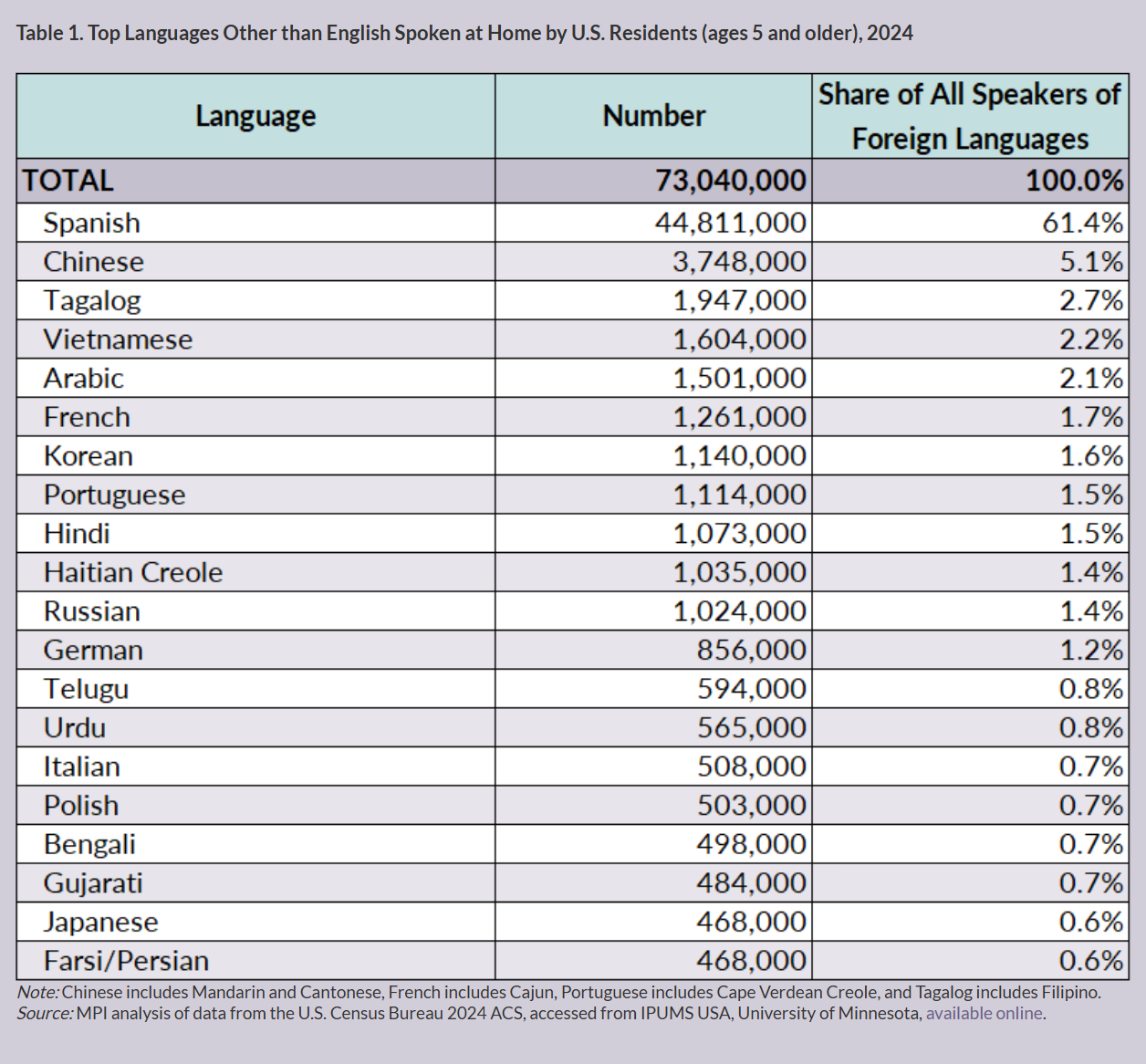
Top languages other than English spoken at home by US residents (ages 5 and older), 2024Note: Chinese includes Mandarin and Cantonese, French includes Cajun, Portuguese includes Cape Verdean Creole, and Tagalog includes Filipino. | Source: MPI analysis of data from the US Census Bureau 2024 ACS, accessed from IPUMS USA, University of Minnesota
Education levels
In 2024, 36 per cent of all 44.2 million immigrant adults ages 25 and older had a bachelor’s degree or higher, a rate similar to that of US-born adults (37 per cent). Newer arrivals tended to be better educated; 45 per cent of immigrants who entered the country between 2020 and 2024 held at least a bachelor’s degree.Educational attainment varied widely by origin, but Indians stood out as the most highly educated group. In 2024, about 82 per cent of Indian-origin adults held at least a bachelor’s degree, placing them ahead of other highly educated groups such as those from Saudi Arabia, Taiwan and Singapore.The trend was even more pronounced among recent arrivals. Among immigrants who entered the US between 2020 and 2024, 88 per cent of Indians were college graduates, the highest share among all nationalities, well ahead of peers from Taiwan, France, Korea and Spain, where the proportion ranged between 80 per cent and 83 per cent.
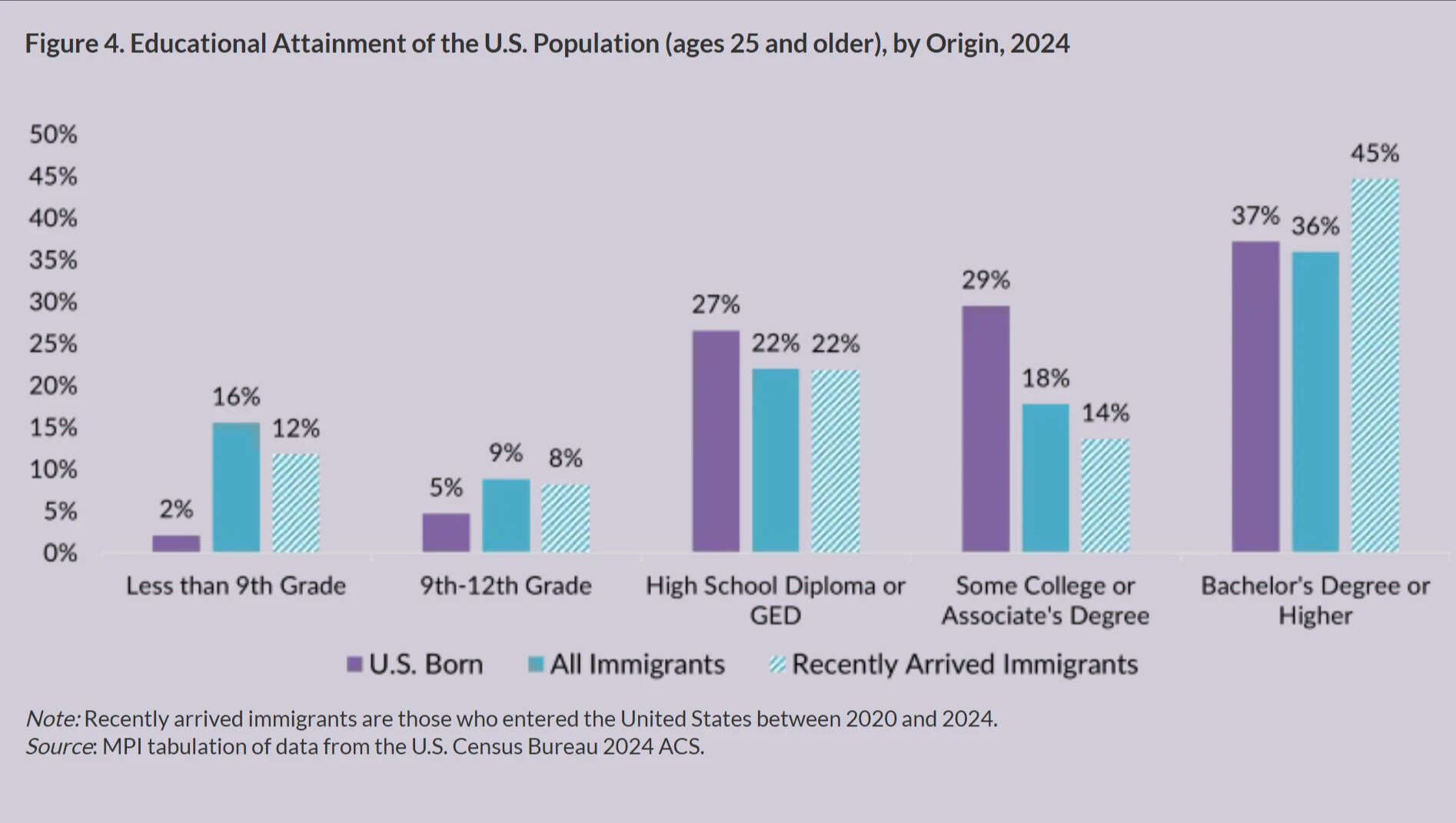
Educational attainment of the US population (ages 25 and older), by Origin, 2024Note: Recently arrived immigrants are those who entered the United States between 2020 and 2024 | Source: MPI tabulation of data from the US Census Bureau 2024 ACS
Green card and backlogs
There are four main pathways to obtain legal permanent residence (green card) status: through a family relationship, employer sponsorship, humanitarian protection (for refugees and asylees), and the Diversity Visa (DV) lottery (not available to Indians). The top countries of nationality for new green-card holders in FY 2024 were Mexico (15 per cent); Cuba (13 per cent); mainland China, the Dominican Republic, and India (5 per cent each); Afghanistan and the Philippines (4 per cent each); Vietnam (3 per cent); and El Salvador and Colombia (2 per cent each). Together, these ten countries were the origins of about 57 per cent of all new green-card recipients in FY 2024.Because of limits on certain visa categories and per-country caps, the US government, in some cases, is still processing applications from decades ago. In March 2026, the State Department was processing some family-sponsored visa applications filed in April 2001 and employment-related visa applications submitted in August 2014.According to the most recent available data, more than 4 million applicants (including spouses and minor children) were on the State Department’s immigrant visa waiting list as of November 1, 2023. (This number does not include prospective immigrants already in the US waiting to adjust their status.) The overwhelming majority of applications in this backlog were from family-sponsored applicants (more than 3.8 million, including principal applicants and their immediate family members), while about 261,000 were applicants for employment-sponsored channels and their families. Of all 4 million applicants, the largest number (1.2 million) were citizens of Mexico, followed by those from India (291,000), the Philippines (288,000), the Dominican Republic (251,000), and mainland China (231,000).
Acquiring US citizenship
Close to 25.8 million immigrants had become naturalised US citizens as of 2024, accounting for about 8 per cent of the total population. Around 818,500 people were naturalised in FY 2024, a slight decline from the previous year.Among green-card holders eligible to naturalise, India again figured prominently. Of the 8.7 million eligible applicants, about 270,000 were Indian nationals, placing them among the top nationalities in line for citizenship.
[ad_2]
Source link