
[ad_1]
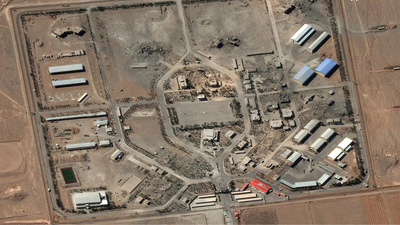
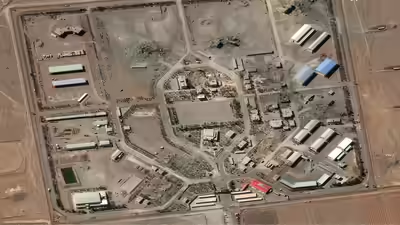
The United States’ reported strike on Isfahan has brought renewed focus to one of Iran’s most sensitive strategic hubs. While Iran has not specified the extent of damage, a media report suggests that American forces used 2,000-pound bunker-buster bombs to strike a large ammunition depot in Isfahan.Donald Trump shared a video on social media showing flames engulfing Iran’s Isfahan facility. Iranian media reported that preliminary findings suggested strikes in central parts of the country had targeted certain “military sites,” though no specific locations were disclosed.The Fars News Agency quoted Akbar Salehi, a security official in the Isfahan governor’s office, as saying initial assessments pointed to some military facilities in the province being hit. He added that details on the scale of damage and any casualties were not immediately available.
Why Isfahan matters
Isfahan, long known for its cultural heritage, has become a central node in Iran’s defence and nuclear infrastructure, especially when US and Israel continue to target its key structures. The province hosts key military and industrial facilities.The province hosts a cluster of critical facilities tied to nuclear research, manufacturing, and defence production, making it central to Iran’s long-term security and technological capabilities.At the core of its importance is its role in Iran’s nuclear programme. According to a report by International Atomic Energy Agency earlier this year, the Isfahan facility houses uranium enriched to 60% purity—just below weapons-grade levels. Experts say such material can be further refined relatively quickly, placing the site at the centre of international scrutiny over Iran’s nuclear ambitions.The infrastructure in Isfahan combines both above-ground and underground elements. While large parts of the industrial complex are spread across open terrain and are visible via satellite imagery, more sensitive materials are believed to be stored in a fortified tunnel network built beneath nearby mountains. This dual structure reflects an effort to balance operational scale with protection of critical assets.The underground tunnel complex, with multiple entry points, is designed to shield high-value materials from external threats and surveillance. However, the exact layout and internal condition of these facilities remain largely unknown, adding to the uncertainty surrounding the site’s resilience and capacity.Beyond nuclear activity, Isfahan also contributes to Iran’s broader defence manufacturing ecosystem, reinforcing its strategic weight. Any disruption to facilities in the region could have implications not only for Iran’s nuclear programme but also for its military supply chain.The attack on Isfahan underscored the intensity of the month-long conflict between the United States and Israel on one side and Iran on the other, which has extended into the wider Gulf region. Iran’s continued chokehold over the Strait of Hormuz, a critical artery for global energy flows, has effectively disrupted shipping, sharply driving up oil prices and unsettling international markets.
[ad_2]
Source link


Квартиры в новостройках https://novye-kvartiry78.ru Кировского района Санкт-Петербурга для комфортной жизни и выгодных инвестиций. Актуальные предложения от застройщиков, студии, одно-, двух- и трехкомнатные квартиры, современные жилые комплексы, удобный поиск по цене, площади и срокам сдачи.
Если человек ведет себя агрессивно, перестал ориентироваться в происходящем, появилась рвота, сильная тревога или психоз, родственникам нужно действовать своевременно. При критических признаках требуется скорая медицинская помощь.
Ознакомиться с деталями – https://4.narcolog-na-dom-krasnoyarsk0.ru