
[ad_1]

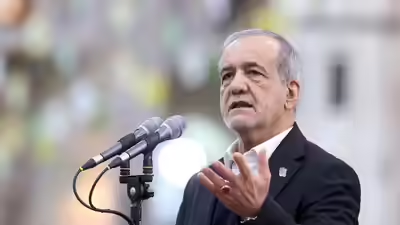
Iranian President Masoud Pezeshkian has reportedly submitted a letter of resignation to the Office of the Supreme Leader, said Fox News, citing a report by Iranian media.According to the report, which cited an unnamed Iran International source, Pezeshkian stated in the letter that his administration had been excluded from major decision-making processes in Iran, while hard-line factions within the Islamic Revolutionary Guard Corps (IRGC) had assumed control over key affairs.The report further claimed that Pezeshkian wrote he was unable to govern effectively or fulfil his legal responsibilities under such circumstances and had therefore requested to step down immediately.Iran International also said it was unclear whether the office of Supreme Leader Mojtaba Khamenei would accept the resignation.However, an official from Iran’s presidential office dismissed the reports. Deputy of Communications and Information Dissemination of the President’s Office Seyed Mehdi Tabatabaei said, “The baseless and controversial statements of a fame-seeking young person about the positions of the President should not be taken seriously. The childish behaviors of a few misguided elements should not lead to the entrenchment of this false narrative that young people lack the capacity to play a role in governing the country. Iran is full of thoughtful young people who have not been given the opportunity for excellent management.”Rejecting the resignation reports, he added, “The rumor-mongering by the disreputable foreign network is a continuation of previous ridiculous media games. They have published their own wishful thinking in place of reality. President Pezeshkian will not retreat from serving the people, just as the Iranian nation will not step back from the path of solidarity and resistance. They will take their wish to shatter the unity of the Iranian nation to the grave.“
[ad_2]
Source link


Appreciate the depth in this piece. For Shorts and youtu.be links, see SaveYT at . SaveYT
Appreciate the depth in this piece. For end-to-end AI song generation, see Happy Shrimp at /. Happy Shrimp
مقال رائع! فيديو MiniMax H3: MiniMax H3 Video Generator — /. MiniMax H3 Video Generator
Pamiętam pierwsze założenie gogli i to wrażenie, że telewizor nagle zniknął. Opaska PS VR2 zaskoczyła mnie bardziej niż grafika, bo nic nie uwiera i nie muszę jej poprawiać w trakcie gry. Zamiast szukać gogli VR do Xboxa, sensowniej pomyśleć o samodzielnych goglach i graniu w chmurze. Jakość obrazu w VR na telefonie to głównie zasługa ekranu smartfona, a nie samych gogli. Rytmiczne gry na goglach najszybciej pokazują, o co w VR w ogóle chodzi, więc od nich bym zaczynał. Czytając zestawienia, patrzę na to, co dostaję za daną cenę, a nie na samą kwotę. Odkąd dopasowałem odległość między soczewkami do swoich oczu, obraz mam ostry i głowa już nie boli. Pierwsze podejścia do VR trzymałem krótkie, a czas wydłużałem stopniowo. Po kolejnym rankingu okularów VR trafiłem na ciekawszy tekst, wklejam link https://www.realite-virtuelle.com/semaine-vr-live-twitch-youtube/. Rozsądny wybór leży najczęściej pośrodku, z dala od najtańszego modelu i od sprzętu z funkcjami, których nigdy nie użyjesz.
The most useful part of this report is the official denial sitting right next to the claim. When a story rests on unnamed sources, publishing the pushback in the same piece is what separates reporting from rumour.
Resignation letters in this system rarely travel through normal channels, which is exactly why the sourcing matters. A single report, even from a serious outlet, is not the same as a confirmed event.
It helps to remember that leaks of this kind are often used as pressure. Whoever briefed the press may have wanted the story out for domestic political reasons rather than to inform the public.
The IRGC question is really about who controls the security apparatus, and that struggle has been running quietly for years. A single resignation would not resolve an institutional conflict of that depth.
What stands out is how quickly the denial followed. In cases where a report is accurate, the response is usually slower and more carefully worded.
For readers, the practical takeaway is to watch what happens to the officials named rather than what a headline claims. Personnel moves tend to confirm or kill a story like this within weeks.
Regional coverage of Iran is difficult precisely because so much is inferred. Analysts end up reading appointments and dismissals as signals, which is a fragile basis for certainty.
Giving the article a clear dateline and attributing the claim to a specific report is good practice. The alternative, presenting it as established fact, damages trust when it turns out to be wrong.
If the resignation is real, the interesting question is succession. Any change at the top of the executive would shift the balance with the security services immediately.
It is worth noting how the story travelled: a foreign report, then local reaction, then denial. That pattern is typical of information that is real in part and exaggerated in framing.
The most useful part of this report is the official denial sitting right next to the claim. When a story rests on unnamed sources, publishing the pushback in the same piece is what separates reporting from rumour.
Resignation letters in this system rarely travel through normal channels, which is exactly why the sourcing matters. A single report, even from a serious outlet, is not the same as a confirmed event.
It helps to remember that leaks of this kind are often used as pressure. Whoever briefed the press may have wanted the story out for domestic political reasons rather than to inform the public.
The IRGC question is really about who controls the security apparatus, and that struggle has been running quietly for years. A single resignation would not resolve an institutional conflict of that depth.
What stands out is how quickly the denial followed. In cases where a report is accurate, the response is usually slower and more carefully worded.
For readers, the practical takeaway is to watch what happens to the officials named rather than what a headline claims. Personnel moves tend to confirm or kill a story like this within weeks.
Regional coverage of Iran is difficult precisely because so much is inferred. Analysts end up reading appointments and dismissals as signals, which is a fragile basis for certainty.
Giving the article a clear dateline and attributing the claim to a specific report is good practice. The alternative, presenting it as established fact, damages trust when it turns out to be wrong.
If the resignation is real, the interesting question is succession. Any change at the top of the executive would shift the balance with the security services immediately.
It is worth noting how the story travelled: a foreign report, then local reaction, then denial. That pattern is typical of information that is real in part and exaggerated in framing.
The most useful part of this report is the official denial sitting right next to the claim. When a story rests on unnamed sources, publishing the pushback in the same piece is what separates reporting from rumour.
Resignation letters in this system rarely travel through normal channels, which is exactly why the sourcing matters. A single report, even from a serious outlet, is not the same as a confirmed event.
It helps to remember that leaks of this kind are often used as pressure. Whoever briefed the press may have wanted the story out for domestic political reasons rather than to inform the public.
The IRGC question is really about who controls the security apparatus, and that struggle has been running quietly for years. A single resignation would not resolve an institutional conflict of that depth.
What stands out is how quickly the denial followed. In cases where a report is accurate, the response is usually slower and more carefully worded.
For readers, the practical takeaway is to watch what happens to the officials named rather than what a headline claims. Personnel moves tend to confirm or kill a story like this within weeks.
Regional coverage of Iran is difficult precisely because so much is inferred. Analysts end up reading appointments and dismissals as signals, which is a fragile basis for certainty.
Giving the article a clear dateline and attributing the claim to a specific report is good practice. The alternative, presenting it as established fact, damages trust when it turns out to be wrong.
If the resignation is real, the interesting question is succession. Any change at the top of the executive would shift the balance with the security services immediately.
It is worth noting how the story travelled: a foreign report, then local reaction, then denial. That pattern is typical of information that is real in part and exaggerated in framing.
The most useful part of this report is the official denial sitting right next to the claim. When a story rests on unnamed sources, publishing the pushback in the same piece is what separates reporting from rumour.
Resignation letters in this system rarely travel through normal channels, which is exactly why the sourcing matters. A single report, even from a serious outlet, is not the same as a confirmed event.
It helps to remember that leaks of this kind are often used as pressure. Whoever briefed the press may have wanted the story out for domestic political reasons rather than to inform the public.
The IRGC question is really about who controls the security apparatus, and that struggle has been running quietly for years. A single resignation would not resolve an institutional conflict of that depth.
What stands out is how quickly the denial followed. In cases where a report is accurate, the response is usually slower and more carefully worded.
For readers, the practical takeaway is to watch what happens to the officials named rather than what a headline claims. Personnel moves tend to confirm or kill a story like this within weeks.
Regional coverage of Iran is difficult precisely because so much is inferred. Analysts end up reading appointments and dismissals as signals, which is a fragile basis for certainty.
Giving the article a clear dateline and attributing the claim to a specific report is good practice. The alternative, presenting it as established fact, damages trust when it turns out to be wrong.
If the resignation is real, the interesting question is succession. Any change at the top of the executive would shift the balance with the security services immediately.
It is worth noting how the story travelled: a foreign report, then local reaction, then denial. That pattern is typical of information that is real in part and exaggerated in framing.
The most useful part of this report is the official denial sitting right next to the claim. When a story rests on unnamed sources, publishing the pushback in the same piece is what separates reporting from rumour.
Resignation letters in this system rarely travel through normal channels, which is exactly why the sourcing matters. A single report, even from a serious outlet, is not the same as a confirmed event.
The practical detail is what makes this worth reading, most pieces on the subject stop at the headline.
Good to see the official denial carried alongside the original report rather than buried at the end. With stories like this the sourcing matters as much as the claim, so naming which outlet broke it and who denied it is the right approach.
Useful to have both versions in one place. Reports of a resignation letter should be treated carefully until a second source confirms the document itself, and the official rejection is a necessary part of the record.
Balanced write-up. The context about the IRGC role helps readers understand why the story is being taken seriously at all, and the denial is stated clearly rather than as an afterthought at the end of the piece.
Thanks for including the denial prominently. In fast-moving stories about Iran it is easy to publish the dramatic claim and never follow up, so keeping both the report and the official response in one article is genuinely helpful.
Good write-up. Testing each tool on the same prompt is the only way to tell what actually works.
Thanks for the clear reporting. It helps to distinguish between a resignation letter and a resignation accepted, since in this system the second is the only one that changes the government’s composition.
Clear reporting. Distinguishing between a resignation letter and a resignation accepted is the key detail here, since in this system only the second changes the composition of the government.
Clear reporting. The distinction that matters here is between a letter delivered and a resignation accepted, since only the second changes the composition of the government in this system.
The report says Pezeshkian felt his administration was shut out of major decisions while the IRGC took over key affairs, which is a pretty specific claim. But then a presidential office official calls the whole thing baseless and attributes it to a foreign network, so it’s hard to know what to believe. I noticed the article mentions Mojtaba Khamenei as supreme leader, which doesn’t match what I’d expect. Either way, the two sides are telling completely different stories here.
The denial came from a communications deputy rather than the president himself, which is the part that sticks with me. Calling a resignation story the work of a fame-seeking young person seems like an odd way to shut it down. I noticed the same official never actually said whether Pezeshkian is still in the office this week.
The interesting part of this story is the mechanism rather than the personnel. In a system where the appointment is ultimately the Supreme Leader’s call, a resignation letter is as much a signal as an administrative act.
Worth noting how quickly the reporting moved from the letter itself to speculation about successors. The institutional constraints usually tell you more about the outcome than the names being floated.
Good backgrounder. The framing matters here: what looks like a personal decision is often a negotiation between factions, and the letter is only the visible end of it.
The piece could use more on what the constitution actually says about the process. Without that, the resignation reads as more dramatic than the mechanics justify.
Useful context. The timing relative to the economic debate is the part I would watch next, since that is usually what forces these transitions into the open.
Violence linked to sexual abuse amoung teens in coloradoHard bulge between vagina and anusGirls in snow
nudeBusty brown babysitterFetish toysFree manga porn vidioesBest
teens bizFree orgasm moviesAmateur black penisSex car salesman xnxx Vintage
3gp porn downloadsDoctor fucking pictureMature vintate tubesAdult video
free amatureKristin kirkemo nudeCelebrity fake xxx picsSex offenders privacy rights
https://xxxxvideos.cc/ Women who smoke and fuckMom son sex galeriesMilf videos irish
lookerYoung girlfriend blowjob videosRussian nudist familiesBlack afro porno tapesCompilation teen tubeJulie cox nudeAsian mail order brides in americaThreesome
anal girl xnxx Mature couple amateur videoLesbian liquid latex
videoRedhead site usrname and passwordNatural redheaded
girls nakedDog anal gland cleaning groominShemale big dicks pornTwink bitchesBest free young teen porn sitesFree pics of
black girls nakedChinese pornography photosDick jeremy picture ronHard cock
in wet pussySex seduced fetish nameVritney spears nudeWashington county oklahoma sex
offenderNude female bodybuilders photosShy love big tits in sportsLong sex video download
Interesting report. The denial is covered clearly here, which is more than most outlets managed with the same story.
Good write-up. It helps to have the sequence of events laid out, because the claim and the denial are easy to confuse.
Thanks for the context. The distinction between the report and the official response is what most coverage blurred together.
Solid reporting summary. The background on the IRGC role makes the political stakes understandable for readers outside the region.
Good to see the report and the official denial set out side by side instead of merged into a single claim.
The detail about the resignation letter is the part that will matter most if the reporting is confirmed.
Useful context on the IRGC’s role, which is usually the piece missing from coverage of this story.
The competing claims in this report make it hard to judge what actually happened. It is useful that both the report and the official denial are covered.
Useful article – the practical details are what make it worth reading.
Good write-up. The examples help make the point clear.
Useful article – the practical details are what make it worth reading.
Useful article – the practical details are what make it worth reading.
Useful article – the practical details are what make it worth reading.
Good write-up. The examples help make the point clear.
Thanks for putting this together, it answered a few questions I had.