

[ad_1]
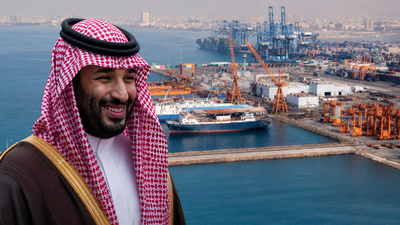
Saudi Arabia is leveraging the Iran war to accelerate its ambitions of becoming a regional energy and logistics hub, even as the conflict disrupts global trade and weighs on economic growth across the Gulf.Since fighting began on February 28, shipping through the Strait of Hormuz has been heavily restricted, forcing Gulf states to rely on alternative routes for energy exports and trade. Saudi Arabia’s decades-old East-West pipeline has allowed the kingdom to keep oil exports flowing, while its Red Sea ports and highway network have absorbed a growing share of regional commerce.“Saudi Arabia has shown it is the indispensable Red Sea backstop,” said Hesham Alghannam, a Riyadh-based scholar at the Malcolm H Kerr Carnegie Middle East Center.The disruption has delivered a major financial boost to the kingdom. Saudi oil export revenue climbed to a more than three-year high of $24.7 billion during the first full month of the conflict, supported by higher crude prices and uninterrupted exports.At the same time, the war is accelerating Crown Prince Mohammed bin Salman’s push to position Saudi Arabia as a global logistics and trading hub connecting Asia, Africa, and Europe.“This war is accelerating Saudi Arabia’s plans to become a key logistics hub between Asia, Africa, and Europe, a title that has been indisputably held by Dubai’s Jebel Ali port for decades,” according to Albert Vidal Ribe, an analyst at the International Institute for Strategic Studies, as quoted by Bloomberg.Saudi Arabia is already reshaping parts of its Neom development project to support those ambitions. Under a revised strategy, Neom’s port in the northwest could become a logistics hub serving European companies trading with the UAE, Kuwait, and Iraq, according to people familiar with the matter.The kingdom’s $1 trillion wealth fund is also considering combining transport and supply-chain assets into a single logistics giant aimed at attracting foreign investment and strengthening Saudi Arabia’s role in regional trade.Investor confidence has also remained relatively resilient during the conflict. Saudi Arabia’s main stock index has gained around 3% since the war began, while markets in Dubai and Abu Dhabi have fallen about 10% and 7% respectively. The stronger market performance has encouraged companies to continue preparations for public listings despite a generally slower year for Gulf IPOs.Still, the wider economic impact of the war is being felt across the kingdom. The International Monetary Fund lowered its 2026 growth forecast for Saudi Arabia by 0.9 percentage points to 3.1% in April, although the downgrade was among the smallest in the Gulf region.Regional competitors are also moving quickly to strengthen alternative trade and export routes. The United Arab Emirates is expanding infrastructure on its east coast and accelerating construction of a pipeline to Fujairah on the Gulf of Oman to double crude export capacity.Oman has also increased its importance in regional trade by launching a new corridor with the UAE emirate of Sharjah, while its Arabian Sea ports continue to gain prominence.Senior US officials said Sunday that Washington and Tehran are nearing a deal that could reopen the Strait of Hormuz, although President Donald Trump said he would not “rush” into an agreement.Even if the strait reopens, analysts believe Gulf countries will continue investing in alternative routes because Iran is likely to retain the ability to threaten shipping in the area.Risks also remain for Saudi Arabia. Shipping through the Red Sea continues to face threats from Houthi attacks in Yemen, although the Houthis have avoided targeting Saudi Arabia during the Iran conflict.
[ad_2]
Source link


Квартиры в новостройках https://novye-kvartiry78.ru Кировского района Санкт-Петербурга для комфортной жизни и выгодных инвестиций. Актуальные предложения от застройщиков, студии, одно-, двух- и трехкомнатные квартиры, современные жилые комплексы, удобный поиск по цене, площади и срокам сдачи.
Багато позицій, на які деінде доводиться довго чекати, тут просто лежать на полиці. Мотоботи з жорстким захистом гомілки виправдовують свою ціну і не розлазяться після кількох виїздів. Найпростіше скинути VIN або номер рами, щоб підбір був точним з першого разу. Ціни тут адекватні, за такі самі деталі в інших місцях просять помітно більше. Підтримка відповідає швидко, навіть на дурнуваті питання новачка. Номер деталі вбиваєш прямо в рядок пошуку, і назву товару вгадувати не треба. Доставку рахують за тарифами перевізника, накруток зверху немає. Частину замовлення довелося повернути після примірки, і кошти віддали повністю. Захист і шолом купував саме тут – магазин мотоекіпірування київ, усе зібране в одному розділі. Перед покупкою уточнюю термін гарантії, щоб потім не було сюрпризів.