
[ad_1]
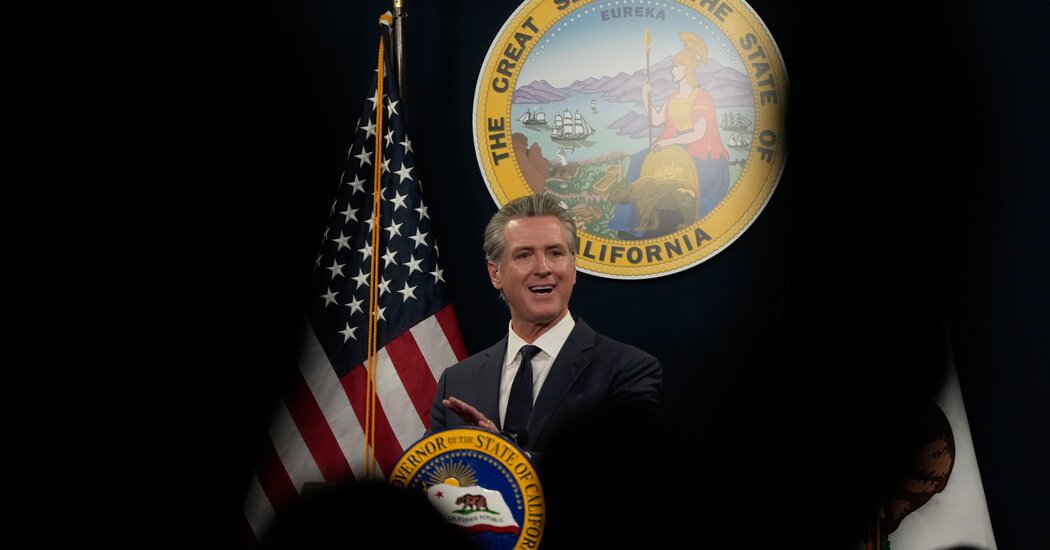
California’s governor, Gavin Newsom, issued an executive order on Thursday to explore a broad overhaul of labor policies, an attempt to front run a potential mass job displacement caused by artificial intelligence.
Mr. Newsom, a Democrat, signed the order mandating state agencies work with academics, labor groups and the A.I. industry to study how to subsidize companies that keep employees rather than replace them with the technology.
The order calls for an expansion of job training programs, particularly for white-collar workers like customer service representatives, software developers, and marketing and sales people whose roles are expected to be eliminated by A.I. Mr. Newsom also ordered an examination of universal basic capital, which would give all residents stakes in assets like corporate stocks, bonds or wealth funds.
Unemployment insurance and other traditional safeguards will not suffice, Mr. Newsom has said. A.I. leaders have warned him of swift and major changes in employment, where entire job categories are at risk of extinction — particularly for white-collar workers.
“California has never sat back and watched as the future happened to us — and we won’t start now,” Mr. Newsom said in a news release. “But we must think bigger. This moment demands that we reimagine the entire system — how we work, how we govern, how we prepare people for the future.”
Mr. Newsom’s executive order, the first of its kind signed by a U.S. governor, reflects a growing global angst. Fears about A.I. have prompted a fierce debate over how best to help individuals transition into new careers or help those facing extended unemployment.
On Wednesday, Meta slashed its work force by 10 percent, or about 8,000 people, citing a further shift in the company’s strategy to A.I. It joined the chip company Intel, the software company Cisco, the e-commerce giant Amazon and other tech companies that have laid off thousands of workers as executives say the technology has created significant efficiency gains.
Dario Amodei, co-founder of the A.I. start-up Anthropic, has predicted that roughly half of white-collar jobs could disappear in the next five years. While other tech leaders disagree with Mr. Amodei’s predictions, nearly all say that the technology will replace humans in fields like communications, law and engineering in the near future.
Governments around the world are responding to A.I.-related job losses with an array of actions and experiments. In China, which currently has a 17 percent youth unemployment rate, courts have ruled in favor of workers who have sued their former employers for compensation after being displaced by A.I.
England, Japan and South Korea have contemplated universal basic income, a policy giving regular cash handouts to residents to make up for labor market disruptions. In the United States, some Democratic lawmakers have also floated legislative proposals for similar pilot projects.
Tech leaders including Elon Musk of Tesla and SpaceX and Sam Altman of OpenAI have said universal basic income may be needed. Mr. Musk has said that productivity from A.I. will amount to a surge in funds available to governments that can be used to compensate individuals who lose their jobs to technology.
“Universal HIGH INCOME via checks issued by the Federal government is the best way to deal with unemployment caused by AI,” Mr. Musk said in a post last month.
While Mr. Newsom’s order directs policy exploration instead of concrete action, California has been a leading state in regulating A.I. The state was the first to pass a comprehensive safety bill on large language models like OpenAI’s ChatGPT, Google’s Gemini and Anthropic’s Claude. Mr. Newsom recently issued an executive order to vet any companies with A.I. contracts with the state for privacy and security guardrails.
California and other states have helped fill a void in federal regulation, in which the White House has largely urged free rein for the companies in a global A.I. race with China. That may change in the wake of Anthropic’s powerful new model, Mythos, which has prompted White House officials to consider an executive order mandating safety testing for new models.
In a speech this week at a conference held by the Center for American Progress, a left-leaning think tank and advocacy organization, Mr. Newsom said he was concerned that companies were getting tax breaks while workers were saddled with taxes on their wages. Tax breaks for companies that automate and displace employees will enrich companies but doubly hurt workers who are still subject to taxation.
The governor’s order does not specifically mention an overhaul of tax policy, but that could be considered as state agencies develop new A.I.-related labor frameworks, the governor’s office said.
Mr. Newsom’s executive order predicts a widening gap between A.I. companies and workers as the industry explodes in profitability and laborers are increasingly left behind. In his order, the governor asked state agencies to focus on ways that collective bargaining by labor groups can help bridge the gap.
“Businesses are going to make a fortune, and that’s why you cannot continue to have a payroll tax system that taxes jobs and then subsidizes automation,” Mr. Newsom said in his speech this week.
[ad_2]
Source link


Закажите G202 https://mismar74.ru/G202.html онлайн. Актуальные цены, наличие на складе, технические характеристики, выгодные условия покупки и быстрая доставка по всей России.