
[ad_1]
Tesla’s profit rose slightly during the first quarter, the company said Wednesday, but was well below levels seen a few years ago as car sales remained tepid.
The carmaker earned $477 million in the first three months of 2026, compared with $409 million a year earlier. Sales rose 16 percent to $22.4 billion, the company said.
Four years ago, in the first quarter of 2022, Tesla reported profit of more than $3 billion. The trend since then has been downward, reflecting the decision by Elon Musk, Tesla’s chief executive, to devote resources to self-driving taxis and humanoid robots that have yet to bring in much revenue.
Tesla car sales appear to have stalled at fewer than two million per year. And the company is earning less money from selling clean air credits to other carmakers because Congress and President Trump have largely dismantled the regulations that required such trading.
In a statement, the company said sales in the United States and Europe had rebounded and were growing in Asia and Latin America as rising fuel prices increased demand for electric vehicles.
“Our focus on affordability and utility across our vehicle lineup continues to be a key competitive advantage, particularly as gas-powered alternatives become more expensive,” the company said.
Wall Street values Tesla at $1.2 trillion, far more than any other automaker, based on promises by Mr. Musk that the company will soon begin mass-producing products using artificial intelligence. Those include a humanoid robot called Optimus and a “Cybercab” that can drive itself.
Tesla said it had broken ground for a facility near another company factory in Austin, Texas, that will eventually produce 10 million robots a year. The company also produced its first Cybercab in February. But it is not clear when or if regulators will approve use or sale of the car, which does not have a steering wheel, brake pedal or side mirrors.
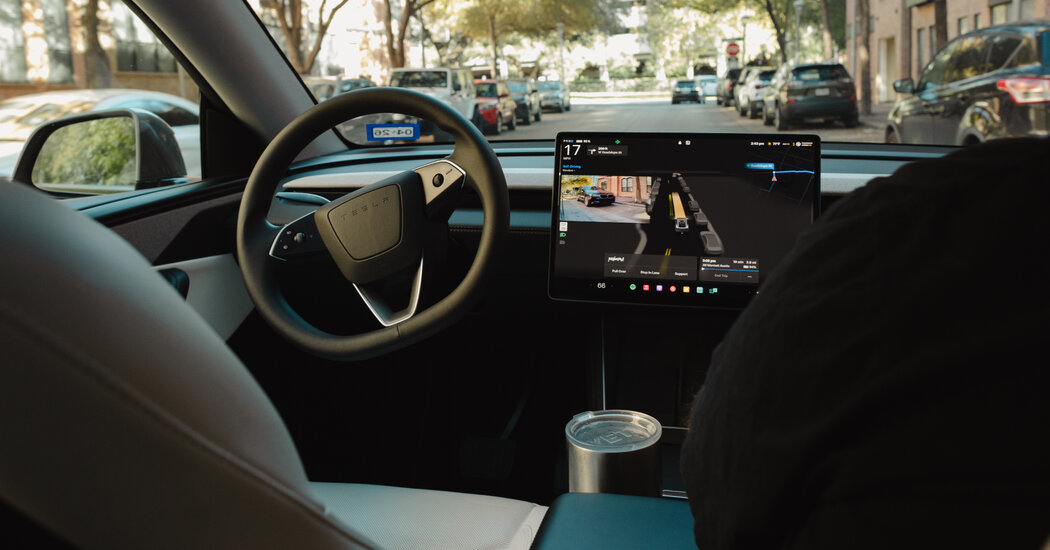
Tesla has begun offering paid rides to customers in Texas in Model Y sport utility vehicles equipped with autonomous driving software. The service began in Austin last year and expanded to Houston and Dallas this month.
Paying customers have ridden more than 1.6 million miles in Tesla taxis, the company said Wednesday. Tesla is making preparations to offer autonomous rides in Phoenix, Las Vegas and three Florida cities: Miami, Orlando and Tampa.
“We’ve got a very exciting year ahead of us,” Mr. Musk said during a conference call on Wednesday. He predicted that Tesla’s self-driving taxis would be operating in a dozen states by the end of the year.
But the number of autonomous taxis so far is small compared with that of Waymo, a unit of Google’s parent company. Waymo is offering paid, autonomous rides in 11 cities and has identified plans for 20 more.
Investors are showing signs of unease. Tesla shares have fallen more than 10 percent since the end of last year.
Tesla continues to contend with intensifying competition, especially in Asia and Europe, where Chinese carmakers are selling vehicles that cost a lot less but offer comparable or superior technology.
Tesla has stopped producing the Model S and Model X, its luxury vehicles, and the Cybertruck pickup has sold poorly.
Almost all of Tesla’s revenue from cars comes from the Model 3 sedan and Model Y sport utility vehicle, which appear increasingly dated especially as Chinese carmakers roll out new models at a dizzying pace.
Tesla’s exit from the luxury market creates an opportunity for other manufacturers offering electric vehicles for people who can afford to spend $80,000 or more.
“Tesla S and Model X customers are more than welcome to visit our stores. We have a car for them,” Sebastian Mackensen, the chief executive of BMW of North America, said in an interview Wednesday.
On Thursday, BMW unveiled a redesign of its top-of-the line 7 Series sedan. An electric version costing $125,000 can travel 350 miles on a charge.
Tesla also faces more competition in the market for large batteries used by electric utilities, businesses and homeowners. Sales of those batteries, an important source of profit, fell 15 percent in the first quarter as measured by their storage capacity, the company said on April 2.
The market for storage batteries, which can be as big as shipping containers and as little as a television, is becoming more competitive. Companies like LG Energy Solution and Ford Motor are taking factories originally designed to produce electric vehicle batteries and outfitting them to make storage products, driving down prices.
At the same time, rising oil prices could stimulate demand for Tesla’s electric vehicles, including the long-awaited Semi, a heavy truck the company is expected to begin delivering in large numbers soon.
The price of diesel, used to power most big trucks, has risen even more than gasoline, to $5.40 per gallon from $3.53 a year ago, according to U.S. government figures.
“In the current backdrop around rising gas prices,” said Melissa Otto, head of research at S&P Global Visible Alpha, “my guess is we are going to see more investors taking a look at Tesla once again.”
[ad_2]
Source link


Vavada atbildigas speles riki ietver iemaksu limitus, sesijas ilguma ierobezojumu un atdzisanas periodu pec limita mainas. Kataloga filtri pec piegadataja, mehanikas un svarstiguma saglabajas starp apmeklejumiem ka nosaukti prieksiestatijumi. Bonusa noteikumi publiceti: https://greenribbonpledge.org/ Sada pieeja padara atgriesanos platforma jegpilnu ari arpus lielo akciju un turniru periodiem.
Vavada izmaksu pieteikumi tiek apstradati no dazam minutem lidz diennaktij atkariba no izveletas maksajumu metodes. Automatiska izmaksa parskaita uzkratos laimestus uz karti vai e-maku pec grafika bez manuala pieteikuma. Registracijas instrukcija pieejama: https://durusgazetesi.com/ Sada pieeja apliecina, ka platforma doma par ilgtermina attiecibam, nevis par vienreizeju apmeklejumu.
Czat pomocy Vavada odpisuje zwykle w kilka minut po polsku, angielsku i rosyjsku. Postep obrotu widac w procentach i pozostalej kwocie, a nie w drobnym druku regulaminu. Aktualny adres znajdziesz tutaj: https://promocja-zdrowia.com/ Taka elastycznosc ustawien pasuje i do wygody, i do osob stawiajacych bezpieczenstwo na pierwszym miejscu.
Нарколог на дом в Луганске — возможность получить медицинскую помощь в привычных и комфортных условиях, если пациенту сложно самостоятельно приехать в клинику. Врач проводит осмотр, оценивает состояние пациента, уточняет анамнез и определяет, какое лечение допустимо дома. Лечение может включать вывод из запоя, детоксикацию, снятие похмелья, постановку капельницы, медикаментозное лечение, последующее кодирование алкоголизма и рекомендации по восстановлению. Вызов нарколога особенно актуален при длительном употреблении алкоголя, выраженном абстинентном синдроме, интоксикации, нарушениях сна и ухудшении работы нервной системы.
Ознакомиться с деталями – нарколог на дом вывод в Луганске