

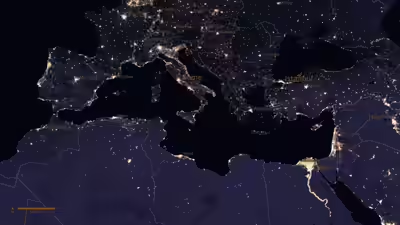
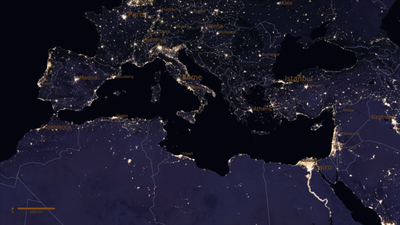
Go out at night when the sky is clear and take a look around more often than not, you’ll see fewer stars than your grandparents did when they were young. And this isn’t just an illusion; satellite measurements now show that the Earth is becoming increasingly bright at night, thanks to the rapid proliferation of artificial light. As humans continue to develop cities and rural areas, they are transforming the darkness of nature. What was once a serene starry sky is slowly but surely fading away into a blanket of light.
Satellite data and the rise of night-time brightness
The latest studies utilising satellite measurements have shown an intriguing pattern emerging: our planet is getting brighter at night, but the process is neither linear nor uniform. For example, NASA’s Change in Night Lights between 2012 and 2023 – EIC Version showed an overall 16% increase in night-time light levels globally from.This phenomenon is particularly fascinating for being multifaceted. Researchers characterise the night-time lighting conditions on Earth as “highly volatile”, continually varying as certain areas get brighter and others darker.This conclusion was reached by analysing millions of satellite photos processed through NASA-funded algorithms, thus providing significantly greater detail than previous studies on the matter.To put it simply, our planet is not only becoming brighter; it is doing so in a dynamic manner reflective of human activity and other factors such as blackouts and military operations.
Causes of light pollution and global brightening
As per Leibniz institute of Freshwater Ecology and Inland Fisheries, increasing artificial illumination by night is the primary cause of this increase in brightness, which is otherwise known as light pollution.The regions of the world witnessing the greatest rises in brightness include sub-Saharan Africa and Southeast Asia. Urbanisation and increased electrification of these areas have been the primary causes of the rise in brightness levels.At the same time, technological advances in lighting have contributed significantly. While LEDs are more efficient, they have led to greater illumination due to their intensity and coverage.Artificial light at night is now a global disruptor of darkness. Nevertheless, not all places in the world are becoming brighter. For example, parts of Europe have taken steps to decrease artificial illumination.
Impact of brighter nights on environment and health
The implications of the increased luminosity of the night sky are more profound than simply depriving us of the starry night. For a long time, scientists have been aware of the fact that light pollution is harmful to the functioning of ecosystems. It affects nocturnal ecosystems, animal migrations, and human circadian rhythms.A lot of species are dependent on darkness and light in order to survive. Birds are guided by light, insects orient themselves with its help, and plants’ activities depend on the alternation of night and day. Artificial light disrupts natural processes, leading to negative consequences.The influence of artificial light is less obvious on humans. Our body’s inner clock needs darkness to regulate our sleep cycle, and increasing brightness at night might be associated with more serious health problems. There is a cultural dimension involved as well: many people cannot observe the Milky Way anymore due to light pollution.However, in all its aspects, it is a clear indicator of the way we affect the nature of the Earth. While development brings undeniable benefits, it also challenges us to find balance so that progress does not come at the cost of losing the natural night altogether.











Leave a Reply