

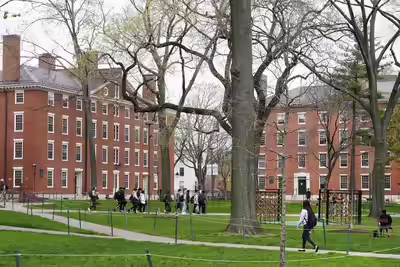
After nearly 19 months of negotiations, Harvard Law School’s clinical staff and the University administration have made limited headway in finalising their first labour contract, underscoring deep divides over core employment and academic issues. Despite more than 100 proposals being exchanged, agreement has been reached on only six of 43 contract provisions so far, according to a report by The Harvard Crimson. The clinical workers, represented by the Harvard Academic Workers–United Auto Workers (HAW-UAW), continue to push for stronger protections around academic freedom, job security, and compensation. While both parties maintain that discussions are ongoing, the slow pace reflects the complexity of drafting a contract from scratch.
Limited progress on procedural provisions
The six agreed-upon provisions largely cover procedural and administrative matters, including access to personnel files, union rights, and information-sharing mechanisms. As reported by The Harvard Crimson, these areas are considered standard and do not address the most pressing concerns of clinical staff.Most substantive issues — including discipline, dismissal, layoffs, and non-renewal policies — remain unresolved, leaving the union without a comprehensive first contract.
Academic freedom and job security at the centre
In the latest round of negotiations earlier this week, union representatives introduced revised proposals addressing academic freedom and employment protections. These include safeguards against arbitrary dismissal and stricter conditions for layoffs, which would only be permitted in cases of a “demonstrably bona fide” financial emergency.Union leaders told The Harvard Crimson that job insecurity can directly impact academic freedom, as clinicians may feel constrained in their teaching or advocacy roles without adequate protections.The academic freedom proposal, first introduced in October 2024, has now been expanded to align with American Bar Association standards requiring law schools to uphold instructors’ First Amendment rights.
Faculty divide complicates negotiations
Union representatives have pointed to a broader structural divide between clinical and doctrinal faculty, which they say has complicated negotiations. As highlighted in The Harvard Crimson report, clinical educators — who combine teaching with hands-on legal practice — feel their contributions are often undervalued within the traditional academic hierarchy.This perceived disparity has become a key backdrop to discussions around academic recognition and institutional support.
Salary disagreements remain unresolved
Compensation continues to be another major sticking point. Harvard previously proposed a minimum starting salary of $68,000 for clinical fellows, while the union has countered with a demand for $86,500 along with a structured framework for raises. The University has yet to respond to the revised salary proposal, The Harvard Crimson reported.
Both sides signal willingness to continue talks
Harvard officials have stated that they remain committed to negotiating in good faith, noting that developing a contract from scratch can be a lengthy process. Union leaders, meanwhile, reiterated to The Harvard Crimson that their goal is not confrontation but recognition of the value clinical educators bring to students and the communities they serve.














Leave a Reply