

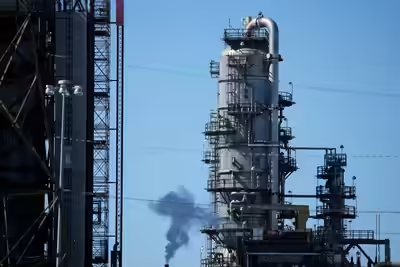
As the Middle East crisis escalates, crude oil prices could surge to $150 or $200 a barrel if the near-closure of the Strait of Hormuz continues over the next six to eight weeks. The disruption is a result of the ongoing war involving the US, Israel, and Iran, which has already prompted Persian Gulf producers to cut millions of barrels of daily supply.According to energy-market consultancy FGE NexantECA, the impact on the global oil market could be enormous. “Every week, 100 million barrels of oil is not going through, and every month, 400 million barrels are not going through,” Chairman Emeritus Fereidun Fesharaki told Bloomberg on Tuesday. “So, within a period of time, these losses to the market will be astronomical,” he said. Fesharaki highlighted that the physical reality of supply disruptions would determine oil prices, rather than political statements.“The market will choke, and the prices will go up. It doesn’t matter what the president says on the political front,” he added. His statement comes as US President Donald Trump has earlier suggested possibility to end the conflict. Oil prices have already surged sharply this month amid the conflict, with Brent crude climbing above $110 per barrel and US West Texas Intermediate (WTI) crude trading above $100. Brent crude rose $2.26, or about 2 per cent, to $115.04 a barrel in early trade, after hitting its highest level since March 19 in the previous session. US WTI crude gained $3.10, or around 3 per cent to $105.96 a barrel, marking its highest level since March 9.Analysts warn that if the Strait of Hormuz remains effectively closed, the global oil market could face further shocks, potentially pushing prices even higher.













Leave a Reply