
[ad_1]
Most of what we see of Elon Musk and Sam Altman, two of Silicon Valley’s most powerful men, comes in the form of carefully curated personas.
Mr. Musk, who prefers to dress entirely in black, associates himself with rockets, home-brewed flamethrowers and even a .50 caliber sniper rifle. Mr. Altman aims for elder statesman vibes, posing for portraits as a kind of heir to Steve Jobs. Tech billionaires, it turns out, care about how the public sees them.
But a rancorous lawsuit between the two has provided a different glimpse of them. For the past two weeks, I’ve spent hours on the fourth floor of the Ronald V. Dellums federal courthouse in Oakland, Calif., loitering in wait for Mr. Musk and Mr. Altman as they face off in a backbiting trial over the artificial intelligence company they co-founded, OpenAI.
Mr. Musk’s lawsuit against Mr. Altman is important, with billions of dollars and the future of the A.I. industry at stake. But the case matters for another reason: It has given an up-close-and-personal look at how two men worth more than a combined $670 billion function under extreme pressure.
Mr. Musk, 54, appeared to have brought a squeezable stress ball along with him, clutching it while fidgeting during his testimony. Mr. Altman, 41, occasionally locked eyes with others while walking from the private witness area to the courtroom. (Mr. Musk has tended to stare at the floor.) And OpenAI’s president, Greg Brockman, 38, was surprisingly tall in person and almost always accompanied by his wife, Anna.
Think of the trial this way: It was like seeing the Wizard of Oz after Dorothy’s cairn terrier, Toto, reveals him.
“The traditional way tech executives operate is to insulate themselves from being perceived as ordinary people by building huge armies of minders, public relations staff and organizational processes to create a wholly manufactured image,” said Dex Hunter-Torricke, the founder of the Center for Tomorrow, a nonprofit addressing societal issues that could arise from A.I. “The moment you have the opportunity to pull back the curtain, Wizard of Oz style, shows how these people really are just human beings.”
In his 2024 lawsuit, Mr. Musk accused OpenAI of taking advantage of his money and breaching its founding agreement to be a nonprofit that gave priority to the public good over commercial interests. OpenAI has claimed the lawsuit is frivolous and intended to slow the company while Mr. Musk builds a competitor. If found liable, OpenAI could be on the hook for $150 billion.
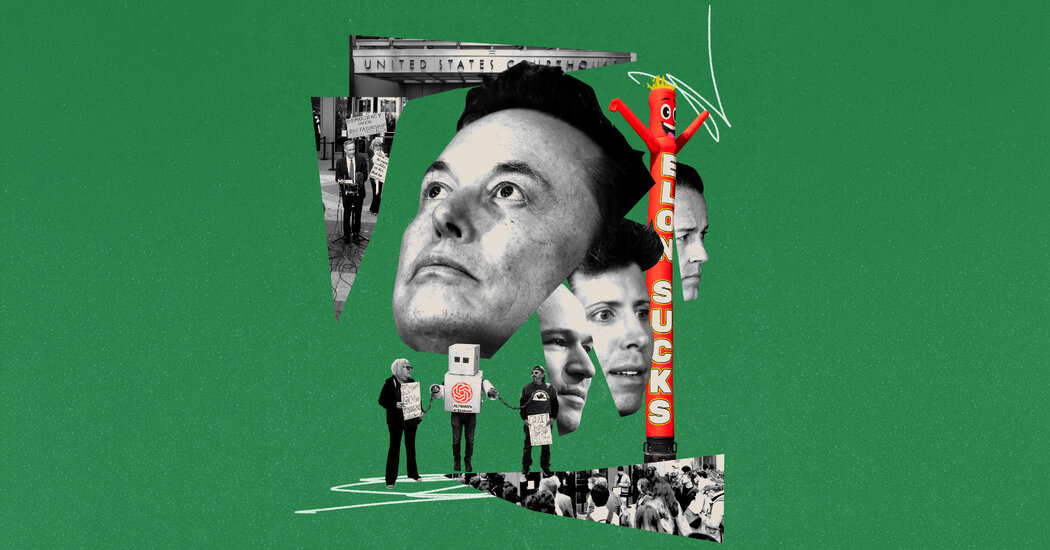
When the trial began the week of April 27, it seemed as if the circus had arrived. Outside the courthouse, a member of Stop AI, a protest group, held an oversize cardboard cutout of Mr. Musk in a bathing suit. It was not designed to be flattering.
Another group brought an inflatable “tube man” — the kind seen outside struggling car dealerships — with the words “Elon Sucks” in white lettering. One woman took a more egalitarian stance with her handwritten sign: “Musk v Altman: Everyone sucks here.”
Not everyone was a hater. I spoke with some local college students who had rushed to the courthouse for a reverent glimpse of Mr. Musk. The court made 30 unreserved seats inside the courtroom available each day, and those hoping to secure one needed to arrive well before the building opened at 7 a.m. or risk being shunted to an overflow room.
One woman dressed in black spent each morning in the building courtyard snapping selfies while taking puffs from a vape pen. She tried taking a photo of Mr. Musk in the courthouse hallway, only to be caught by U.S. marshals and then scolded by the judge, Yvonne Gonzalez Rogers, for breaking the rules against recording in the building. The marshal made the woman delete her photos.
Other attendees were clearly there for entertainment. An older gentleman in the gallery once took his shoes off before eating a packed lunch. A marshal eventually whispered to him, “You’re not in your living room.”
Mr. Musk and Mr. Altman persuaded the court to let them enter the building through the garage, bypassing hoi polloi pressed against the glass of the front door. Not all of the tech elite were afforded the same courtesy; Mr. Brockman walked through the main entrance, as did Shivon Zilis, a former OpenAI board member and the mother of four of Mr. Musk’s children.
The tech titans were mostly on good behavior and in their good clothes. (Mr. Musk in a black suit, with Mr. Altman and Mr. Brockman in gentler blues.) Mr. Musk and Mr. Altman did not interact with each other much, except for occasionally trading icy stares.
During his testimony, Mr. Musk portrayed himself to the nine-person jury as a bold entrepreneur whose primary concern was the survival of the human race. “We want a Gene Roddenberry outcome like ‘Star Trek,’” he said about how to responsibly develop A.I. “Not so much a James Cameron movie like ‘Terminator.’”
At other times, Mr. Musk grew visibly frustrated with William Savitt, OpenAI’s lawyer. Mr. Musk, who at one point called himself an “extremely literal person,” said Mr. Savitt’s questions were “misleading” and “designed to trick him.” When Mr. Musk snapped back with a sarcastic response, a few younger men in the gallery chuckled and seemed to quietly cheer on the sass.
Mr. Altman, who has yet to testify, was more toned down. He spent the trial’s first three days in the gallery’s front row, next to Mr. Brockman and Joshua Achiam, whose mandate at OpenAI is to care about A.I. safety. (It was probably no accident that in a trial discussing A.I.’s potential dangers, Mr. Achiam was seated front and center.)
During Mr. Musk’s testimony, Mr. Brockman scribbled pages of notes in red pen on a legal pad, a journaling habit he said he picked up 16 years ago. Paradoxically, his early career journals were being used against him as evidence in the trial, which, Mr. Brockman said at the trial, was “very painful” for him.
Mr. Altman often stared straight ahead and sometimes shifted in his seat, perhaps made uncomfortable by Mr. Musk’s uncharitable view of OpenAI or from seven hours of sitting on the unforgiving hardwood of a courtroom bench.
Some of Mr. Musk’s allies came prepared. Ari Emanuel, the Hollywood superagent and chief executive of WME Group who is a Musk confidant, showed up as part of Mr. Musk’s entourage, accompanied by a bodyguard who carried a green Harrods bag containing two plush, cream-colored pillows. (The protesters’ cardboard cutout photo of Mr. Musk? It was snapped by paparazzi a few years earlier when the billionaire summered with Mr. Emanuel on a superyacht off the Greek island of Mykonos.)
Mr. Emanuel, who flew in from Los Angeles for the trial, was dressed in the type of blue windbreaker that billionaires wear to the annual Allen & Company technology and media conference in Sun Valley, Idaho. He was chatty with reporters in the hallway between breaks in testimony. Not with me, however; Mr. Emanuel thrice ignored my overtures to talk about the case.
Most witnesses did not appear thrilled to be there. Under cross-examination by OpenAI’s lawyers, Ms. Zilis gave terse responses, adding the occasional sarcastic aside. Mira Murati, OpenAI’s former chief technology officer, did not attend at all; the week her video deposition played in court, she was across the country in Manhattan for the Met Gala.
(The New York Times has sued OpenAI and Microsoft, claiming copyright infringement of news content related to A.I. systems. The two companies have denied the claims.)
With roughly a week of testimony left before jury deliberations, the carnival outside the courthouse has quieted. The audience lines have shortened, the protest balloons deflated.
But there is still more to be revealed. Mr. Altman and Microsoft’s chief executive, Satya Nadella, are expected to testify this week. And last Wednesday, lawyers released a trove of text messages among OpenAI executives during one of the company’s most chaotic periods, when Mr. Altman was briefly fired by the board in 2023.
At the time, OpenAI leaders put on brave public faces. But the texts revealed what happened in private. In one exchange between Mr. Altman and Ms. Murati, who would later describe trying to stabilize the company as it faced a potential implosion, he peppered her with questions about his chances of survival as OpenAI’s chief executive.
“Sam this is very bad,” she wrote.
[ad_2]
Source link

Pamiętam pierwsze założenie gogli i to wrażenie, że telewizor nagle zniknął. Kupując używane gogle PS VR do PS4, zapytałbym sprzedawcę, czy w zestawie jest kamera. Jeśli marzysz o VR, a masz tylko Xboxa, to i tak zostaje ci komputer ze SteamVR albo gogle autonomiczne. Śledzenie ruchu w goglach na telefon obejmuje tylko kręcenie głową, więc do gier to raczej zabawka. Gry VR na PC ruszyły mi dopiero po wymianie karty graficznej na mocniejszą. Najdroższe gogle dają śledzenie rąk i całego pomieszczenia oraz wyraźniejszy obraz, ale nie każdy z tego korzysta. Regulacja rozstawu soczewek to podstawa, bo przy złym ustawieniu oczy męczyły mi się błyskawicznie. W goglach typu Cardboard start sprowadza się do włożenia telefonu i uruchomienia aplikacji. Jeśli nadal siedzisz na VR do telefonu, zerknij tutaj: ciekawy materiał o goglach. Przymierz gogle u znajomego albo w sklepie, bo komfort na głowie mówi więcej niż jakikolwiek ranking.