[ad_1]
Across Europe, the lesson from an old proverb just might be taking hold: Fool me once, shame on you; fool me twice, shame on me.
For the second time in under five years, Europe is contending with an energy crisis set off by a war. Europeans have responded to the price shock by rushing to line up heat pumps, solar panels and electric vehicles. They are hoping to lower their bills and reduce their reliance on imported fossil fuels.
In March, the first month of the war in the Middle East, more than 344,000 electric vehicles were registered across Europe, over 40 percent more than a year earlier, according to the European Automobile Manufacturers’ Association. Solar panel sales for Britain’s biggest power company, Octopus Energy, jumped 50 percent. And in Germany, inquiries about residential solar systems doubled compared with recent months, according to E.ON, an energy company.
Over the first three months of the year, about 575,000 heat pumps were sold in 11 large European countries, up 17 percent from a year earlier, the European Heat Pump Association said. The increases were particularly large in France, Germany and Poland.
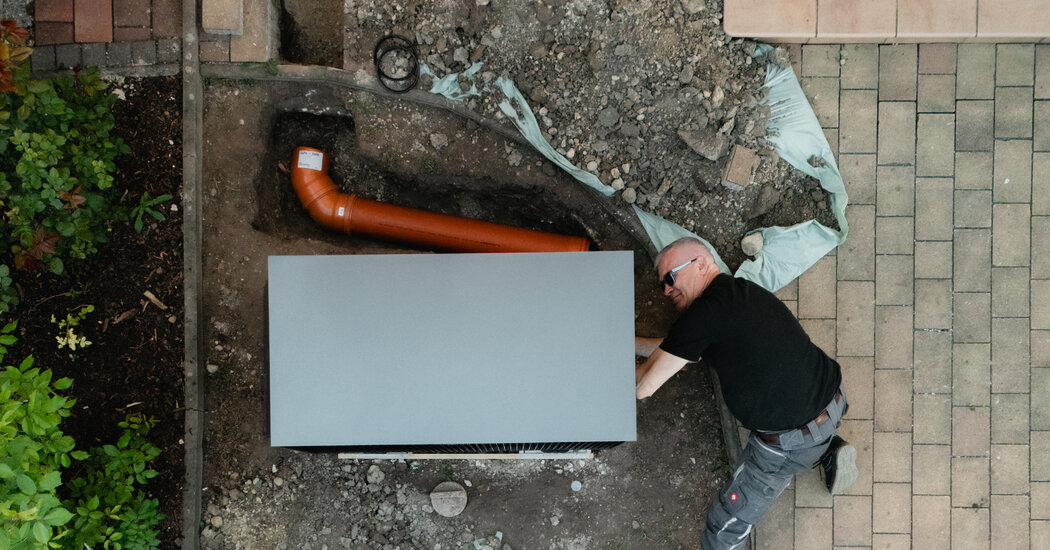
For Heizma, an Austrian company that installs heat pumps, solar panels and other residential electrification services, sales in March and April broke records.
Since the war stopped a vast majority of fuel shipments through the Strait of Hormuz, the price of European natural gas, which is relied on to heat homes and power factories, has risen about 40 percent.
As prices spiked, interest in alternative energy supplies kept rising. Michael Kowatschew, a founder of Heizma, said customer inquiries were up 20 percent. Many of them invoked the importance of “resilience” and “European sovereignty.”
Russia’s invasion of Ukraine in 2022 was a jolt for Europe, which had been dependent on Russia for critical supplies of energy. European governments turned to other gas and oil exporters, including the United States.
Europeans are noticing “more and more how dependent we are not only on fossil fuels but, through fossil fuels, on other countries and other regions,” Mr. Kowatschew said.
The European Union has spent an additional 24 billion euros on energy imports in under two months, said Ursula von der Leyen, the president of the European Commission.
“Households are now seeing that they are only one Trump-ignited war away from very expensive tank refueling or heating bills,” said Elisabetta Cornago, an energy and climate policy expert at the Center for European Reform.
This “shock-awareness factor” means that demand for electric vehicles, heat pumps and solar panels is likely to keep rising, she said.
Demand has increased even as European governments have started to cut taxes on energy bills and diesel and gasoline at the pump to shield households. The costs of solar panels and electric vehicles, still out of reach for some households, are becoming more affordable. Last week, Volkswagen, Europe’s largest automaker, revealed a new electric vehicle model with a starting price under €25,000 (about $29,000), more than 25 percent below a comparable VW popular model.
In Britain, the government said it would allow the sale of plug-in solar panels within the next few months. These devices, which can be attached to a balcony, can help curb energy bills and don’t require the more expensive installation of rooftop panels. They will be widely available in supermarkets and online.
In the meantime, rooftop solar has become more popular. Danny Hirst, the managing director at the Green Way Solar, which installs solar panels in England, has noticed a sharp increase in interest. Last fall, his company was receiving about 10 inquiries a week. Now, it sometimes gets 20 in a single day, he said.
“The general feeling that we’re hearing from clients now is that they’re just getting fed up with the uncertainty of energy prices,” Mr. Hirst said.
But will the interest be sustained? Companies and business groups said it was too soon to know.
For customers, there’s red tape. It can take weeks or months, partly because of regulatory approvals, for a customer to go from deciding to buy a heat pump or solar panels to installing them.
Then there is the push-pull issue of government policies over financial incentives or subsidies, which can drive consumer demand but cause it to taper if they are not designed properly.
Since the war started, countries across Europe have already put in place short-term measures to lower energy costs — more than €10 billion worth, according to an estimate by Bruegel, a think tank in Brussels.
The measures, such as tax cuts on gas at the pump and electricity bills, are predominately aimed at large parts of the population. Experts said governments should target their assistance to the most vulnerable households, while spending more to subsidize low-carbon energy.
This has echoes of the crisis from 2022. At the time, Europe had suddenly shifted away from Russian gas imported via pipelines, a prominent source of fuel. Energy prices rose sharply. Demand for electric vehicles, solar panels and heat pumps jumped.
But when Europe found other sources of natural gas and prices dropped from their peak, interest in renewable technologies waned. Meanwhile, governments had spent hundreds of billions of dollars to shield households and businesses from high energy costs, further reducing the urgency for households to switch to renewables, some analysts said.
Simone Tagliapietra, an energy and climate policy expert at Bruegel, said the lesson for policymakers from 2022 was that they should increase their support for low-carbon technologies, not broad based-measures that cheapen energy from oil and gas. The moment, he said, presents an opportunity for governments.
“We are facing a full-fledged oil and gas crisis,” Mr. Tagliapietra said.
At the same time, history shows that financial incentives needed to sustain consumer interest in technologies like solar panels must be consistent.
Mr. Hirst of the Green Way Solar has been in the solar industry for nearly a dozen years and has experienced the market’s ups and downs. There was a boom right after the 2022 crisis, he said, but then sales dropped. The promise of subsidies drove up interest in renewable technologies, but consumers then waited to make sure they received a subsidy before deciding to install solar panels or heat pumps.
There is a risk that this could happen again.
In Austria, demand for heat pumps dropped in the first three months of this year when some government funds for subsidies ran out.
Mr. Kowatschew at Heizma, the Austrian installation firm, said he was cautious about expanding too quickly. The company was established only two years ago. Its focus is on finding ways to make the installation process faster and more efficient so that workers can outfit two heat pumps a week instead of one, he said.
Still, business is good. Heizma made about €2 million in revenue in April, he said.
“Everyone now knows electrification makes sense,” he said. “It makes a lot of sense to switch to heat pumps, to solar and green electricity.”
[ad_2]
Source link