
[ad_1]
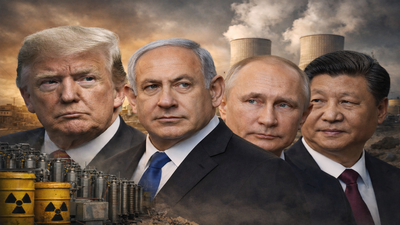
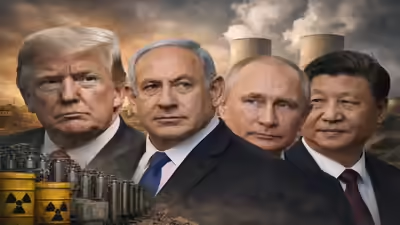
Iran’s enriched uranium stockpile has become the centerpiece of an increasingly complex global power contest, with the United States, China and Russia all seeking a role in determining its future, while Tehran insists the material will not be handed over to anyone.What was once a technical issue inside nuclear diplomacy has now become one of the most politically charged questions in international relations. For Washington, control over Iran’s uranium could mean preventing any future nuclear weapons pathway. For Moscow and Beijing, it offers influence over the shape of a future Middle East settlement. For Iran, it represents sovereignty, strategic leverage and national prestige.
The issue burst back into the spotlight after US President Donald Trump claimed Washington and Tehran were moving toward an agreement under which Iran’s uranium would be recovered and eventually brought to the United States.Speaking to Reuters in a phone interview, Trump said the United States would work jointly with Iran to retrieve the stockpile.“We’re going to get it together. We’re going to go in with Iran, at a nice leisurely pace, and go down and start excavating with big machinery,” Trump said. “We’ll bring it back to the United States.”Trump added that the material, which he described as “nuclear dust,” would be recovered “very soon.”Iran immediately rejected the suggestion.“Iran’s enriched uranium is not going to be transferred anywhere; transferring uranium to the United States has not been an option for us,” Iranian Foreign Ministry spokesperson Esmaeil Baghaei said.The sharp contradiction has exposed one of the central unresolved disputes in negotiations reportedly mediated by Pakistan, with support from Egypt and Turkey.
Why Iran’s uranium matters so much
Uranium in its natural form cannot be directly used in nuclear weapons. It must first be enriched, a process that increases the concentration of the uranium-235 isotope.Low-enriched uranium is commonly used for civilian nuclear reactors. Highly enriched uranium can potentially be used in nuclear weapons.Western officials estimate Iran possesses a substantial stockpile at multiple enrichment levels. According to US assessments cited in international reports, Iran has roughly 450 kilograms enriched to 60 percent purity, around 1,000 kilograms enriched to 20 percent and about 8,500 kilograms enriched to 3.6 percent.The 60 percent stockpile is especially sensitive because it is considered only a short technical step from weapons-grade enrichment of about 90 percent.That makes Iran’s uranium one of the most closely watched nuclear stockpiles in the world.Iran denies seeking nuclear weapons and says its nuclear activities are solely for peaceful civilian use.
What is “nuclear dust”?
Trump’s use of the phrase “nuclear dust” is not a technical scientific term. It appears to be a political description for uranium material that he believes remains buried, damaged or dispersed following earlier military strikes on Iranian nuclear infrastructure.The phrase likely refers to enriched uranium or uranium compounds stored inside damaged underground facilities, especially near Isfahan, where parts of Iran’s nuclear program were reportedly hit during previous attacks.Experts say uranium does not simply disappear after a strike. Depending on storage conditions, it can remain recoverable in containers, sealed chambers, buried debris or damaged tunnels. That is why Trump suggested excavation with “big machinery.”In practical terms, “nuclear dust” means residual nuclear material that may still have strategic value even if facilities around it were destroyed.
Why the United States wants it
For Washington, removing Iran’s uranium would be the most direct way to reduce Tehran’s ability to quickly move toward a nuclear weapon.Trump has framed the issue as proof that his administration can secure a stronger arrangement than previous nuclear agreements.Trump also said Thursday that Iran had agreed to “a very, very powerful statement… that they will not have nuclear weapons.”If the uranium were transferred to the United States or neutralized under U.S.-backed supervision, Trump could present it as a major diplomatic victory and a core security achievement.He also projected confidence about the talks.“I think the deal will go very quickly. We’re getting along very well with Iran,” he said.
Why Russia wants a role
Russia has publicly renewed its offer to host Iran’s enriched uranium under a future settlement.The Kremlin said Moscow remains ready to take custody of the material, reviving an approach used in earlier diplomacy.“This proposal was voiced by President Putin in contacts with both the United States and regional states. The offer still stands, but has not been acted upon,” Kremlin spokesperson Dmitry Peskov said.Russia previously played a significant role in the 2015 nuclear agreement, when Iran shipped low-enriched uranium abroad as part of compliance measures.For Moscow, handling the stockpile would restore influence in nuclear diplomacy, expand its Middle East relevance and position Russia as an unavoidable intermediary between Washington and Tehran.
Why China is interested
China has also emerged as a possible player.Reports citing diplomats familiar with Beijing’s thinking say China is open to taking custody of Iranian uranium or down-blending it to lower enrichment levels suitable for civilian use if both Washington and Tehran agree.China’s interest is strategic and economic.Beijing is Iran’s largest trading partner and biggest buyer of Iranian oil. It has strong incentives to prevent further conflict in the Gulf and keep energy flows stable through the Strait of Hormuz.A Chinese role would also boost Beijing’s diplomatic standing and reinforce its image as a stabilizing force in global crises.Trump is expected to travel to Beijing for talks with Chinese President Xi Jinping, where Iran is expected to be on the agenda.
Why Tehran refuses to give it up
For Iran, the uranium issue is not only about nuclear science. It is deeply tied to politics, prestige and sovereignty.Iranian leaders have long portrayed enrichment capability as a symbol of technological progress and resistance to foreign pressure.Analysts say surrendering the stockpile to the United States would be politically difficult to defend domestically.“Iran’s attachment to uranium enrichment is deeply ideological,” Prof. Ali Ansari told the Guardian. “It is almost an obsession with national prestige.”Even if Tehran accepted inspections, temporary caps or outside monitoring, physically handing over uranium could be viewed internally as capitulation.That helps explain the immediate and categorical rejection of Trump’s claims.
Why removing it would be difficult
Even if a political agreement were reached, physically extracting the material may be one of the hardest parts of any deal.Some of the uranium is believed to be stored in underground tunnels or damaged facilities near Isfahan.Military and nuclear experts have warned that any retrieval mission would require excavation, secure transport, radiation precautions and international verification.One expert described the challenge starkly.“You’ve got basically a half ton of what’s effectively weapons-grade uranium that you’ve got to extricate. And there are a million things that could go wrong.”That means a diplomatic breakthrough would only be the first step. Implementation could take weeks or months.
$20 billion report adds controversy
Fresh questions also emerged after Axios reported that the United States had considered releasing $20 billion in frozen Iranian assets if Tehran gave up its uranium stockpile.The report said Washington had earlier been prepared to release $6 billion for humanitarian purposes, while Iran sought $27 billion.Trump strongly denied that money was part of any arrangement.“It’s totally false. No money is changing hands,” he said.He later posted on Truth Social: “No money is changing hands.”A White House spokesperson added that the administration would “not negotiate through the press” and that anonymous sources “have no idea what they are talking about.”
What happens next
Negotiators are expected to continue talks in coming days, but the uranium dispute remains the clearest measure of whether a broader settlement is truly possible.Washington wants guarantees that Iran cannot rapidly move toward a bomb. Iran wants sanctions relief, security assurances and recognition of its right to peaceful nuclear energy.Russia and China see an opportunity to shape the outcome.Whether Iran’s uranium is removed, diluted, stored abroad or retained under strict monitoring may determine whether diplomacy succeeds or collapses.For now, one stockpile of uranium has become the strategic prize that the United States, China and Russia all want, and the one asset Tehran refuses to surrender.
[ad_2]
Source link


Заказать быстро доставка букетов можно в онлайн-каталоге. Выбирайте ароматные лилии для коллег. В ассортименте собраны монобукеты. Указывайте адрес получателя и дарите положительные эмоции без повода.
Ищете товары для охоты? каталог товаров для охоты предлагает большой ассортимент для охоты и отдыха на природе. В каталоге доступны охотничья экипировка, охотничья одежда, треккинговая обувь, оптика, аксессуары и товары для активного отдыха. Подбирайте нужное снаряжение, сравнивайте характеристики и покупайте продукцию через сайт. Большой ассортимент поможет быстро найти нужные товары.
Нужно иптытание средств измерений? срок утверждения типа средств измерений организация испытаний, подготовка документов, получение свидетельства и внесение СИ в Госреестр. Сопровождение процедуры на всех этапах с учетом требований законодательства.
Нужно иптытание средств измерений? https://utverzhdenie-tipa-sredstv-izmereniy.ru организация испытаний, подготовка документов, получение свидетельства и внесение СИ в Госреестр. Сопровождение процедуры на всех этапах с учетом требований законодательства.
Читать далее: https://dostavka-stroy.ru
Смотреть полный текст: https://fashion-stroy.ru
An informative online resource healthfare.ca focused on healthy living, nutrition, and self-care. The resource provides practical guides on everyday nutrition, along with practical advice. The site also offers product overviews. Special attention is given to balanced daily habits, nutrition and food choices, physical activity, wellness routines, and a healthier lifestyle.
С комфортом онлайн где можно купить игровой компьютер для гейминга. Среди доступных моделей можно подобрать мощные ПК. Выбирайте системный блок с учетом требований игр. Перед покупкой смотрите на SSD. В требовательных играх имеют значение производительная видеокарта. Добавляйте в корзину через сайт и оформляйте доставку по нужному адресу.
Находите современные зона сериалы онлайн в любое время. В онлайн-коллекции представлены зарубежные картины. Ищите кино из тематических подборок. Поклонники комедий смогут подобрать кино по вкусу. После рабочего дня выбирайте фильм. Продолжайте просмотр без привязки к телепрограмме. Понятная навигация поможет выбрать подходящий сериал.
Откройте для себя игровой формат pin up casino в удобном онлайн-режиме. Откройте доступную категорию и приступайте к игре. В разделе развлечений представлены игровые категории. Готовы попробовать? Открывайте игровой раздел. Играйте ответственно и контролируйте время и расходы.